
Football fans want a clear, bright, and smooth picture when they watch live matches. Modern televisions use different display technologies to create this picture. The two most popular premium television technologies in 2026 are OLED and Mini-LED.
OLED televisions control light at the individual pixel level. This process creates perfect black colors. Mini-LED televisions use thousands of small lights behind the screen. This backlight system creates extremely high brightness.
Choosing between an OLED television and a Mini-LED television depends on your room environment and your viewing habits. This guide explains the differences between OLED and Mini-LED screens. This information will help you choose the best television technology for streaming live football.
Quick Answer
Both OLED and Mini-LED televisions are excellent for live football, but they suit different rooms.
An OLED television is the best choice for dark rooms or rooms with controlled lighting. OLED screens offer perfect viewing angles and instant motion response. This instant response keeps fast camera movements very clear.
A Mini-LED television is the best choice for bright rooms with large windows. Mini-LED screens can become much brighter than OLED screens. This extra brightness easily overcomes sunlight and screen reflections during daytime football matches.
Motion Handling for Fast Sports
Live football broadcasts feature fast camera movements and quick player actions. A television must have excellent motion handling to keep the moving football clear on the screen.
OLED televisions have an almost instant pixel response time. This means the individual pixels change color immediately. Fast football passes look very sharp on an OLED screen. There is almost no motion blur behind the players.
Mini-LED televisions also have very good motion handling. Modern Mini-LED televisions use advanced picture processors to keep sports clear. However, the pixel response time of a Mini-LED screen is slightly slower than an OLED screen. You might see a very small amount of blur behind the football during very fast movements. If you want maximum motion clarity, you should also consider the refresh rate of the panel. Our guide to choosing a 60Hz vs 120Hz TV for Live Football explains why refresh rates matter for sports.
Screen Brightness and Room Lighting
Most live football matches happen during the afternoon or early evening. If you watch football in a bright living room, television screen brightness is very important.
Mini-LED televisions produce extremely high brightness. The Mini-LED backlight system pushes powerful light through the display panel. This high brightness stops glare and stops reflections from windows. If sunlight hits your television directly, a Mini-LED screen will still look colorful and clear.
OLED televisions are generally less bright than Mini-LED televisions. An OLED screen can look dim in a very sunny room. Newer 2026 OLED models use advanced panel technologies to increase brightness. These new OLED panels are brighter than older models. However, a Mini-LED television still performs better in direct sunlight.
Viewing Angles for Group Viewing
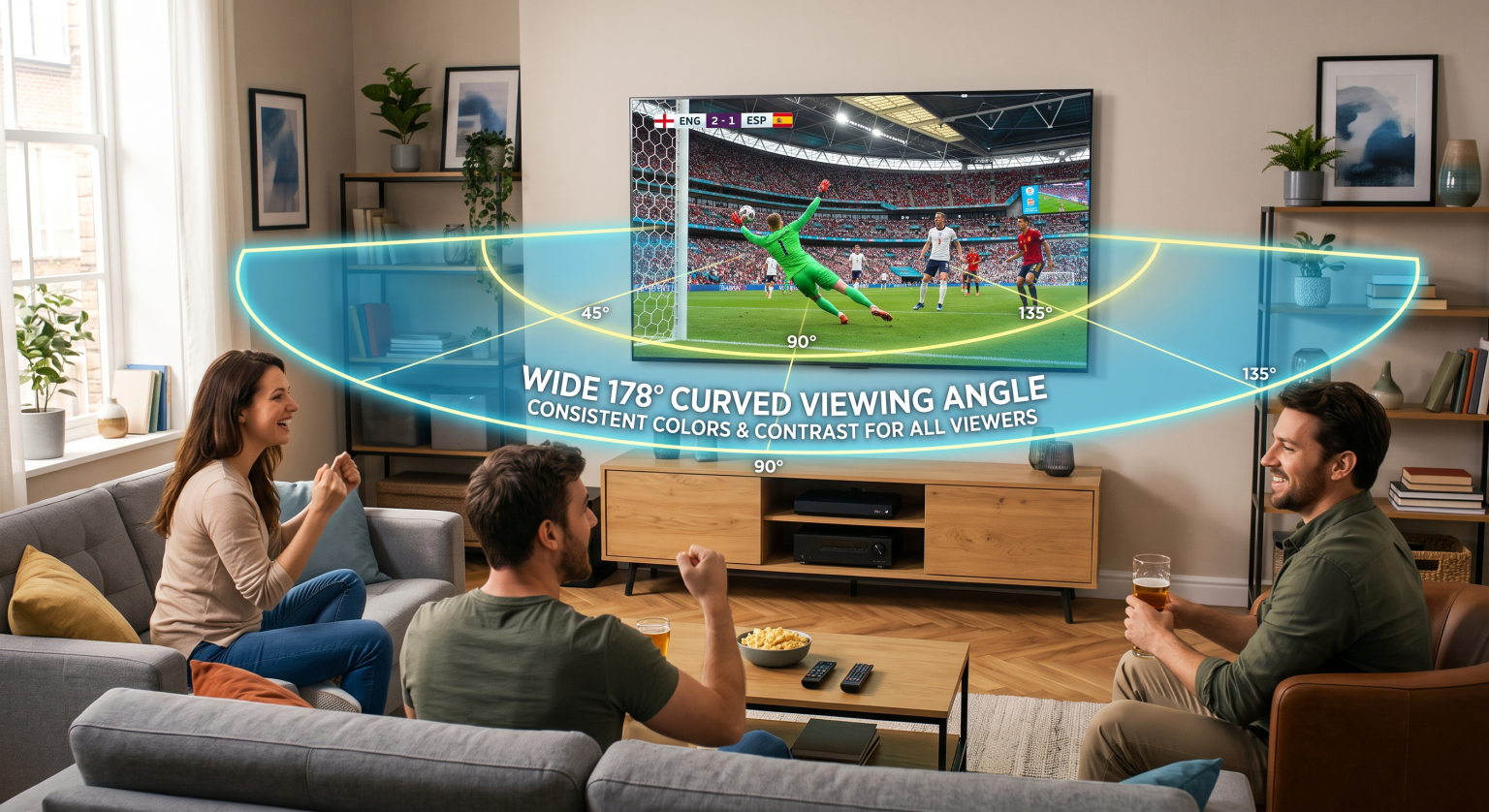
Football is a social sport. Many people watch important matches with a group of friends and family. When many people sit in a wide circle around the television, viewing angles become very important.
OLED televisions provide perfect viewing angles. The picture quality stays identical, even if a person sits far to the left side or the right side of the screen. The colors do not fade.
Mini-LED televisions have narrower viewing angles. If a person sits on the far side of a Mini-LED screen, the television colors can look faded. The screen contrast can also decrease. If you have a wide seating arrangement in your living room, an OLED television is the better technology for group viewing.
OLED vs Mini-LED: Comparison Table
| Feature | OLED Television | Mini-LED Television |
| Screen brightness | Good | Excellent |
| Black color levels | Perfect | Very good |
| Viewing angles | Perfect | Average to Good |
| Motion clarity | Instant pixel response time | Fast pixel response time |
| Best room lighting | Dark or medium room lighting | Bright or sunny room lighting |
| Risk of screen burn-in | Low risk | Zero risk |
Risk of Screen Burn-in
Football broadcasts often show static graphics on the screen. These static graphics include the match timer, the scoreboard, and the television channel logo.
OLED televisions have a small risk of permanent screen burn-in. Burn-in happens when a bright, static image stays on the screen for hundreds of hours. Over time, a faint shadow of the scoreboard becomes permanently visible on the OLED panel. Modern OLED televisions include software features that prevent burn-in automatically. If you watch different types of content, the burn-in risk is very low.
Mini-LED televisions do not suffer from screen burn-in. You can watch sports channels with static scoreboards all day. The Mini-LED screen will not take permanent damage.
Picture Upscaling for Live Broadcasts
Many live football matches are broadcast in 1080p resolution or 720p resolution. Modern OLED and Mini-LED televisions have 4K resolution screens. The television must upscale the lower-resolution football match to fit the 4K screen.
Both OLED and Mini-LED televisions use internal computer processors to upscale the picture. Premium television brands include excellent upscaling software. The display technology (OLED or Mini-LED) does not process the image. The internal television processor handles this task. You can learn more about this process in our article about What Is TV Upscaling and Does It Help IPTV?.
Streaming Live Football with IPTV
Many football fans use IPTV services to stream live sports. The physical display technology does not change how an IPTV application operates. Both OLED Smart TVs and Mini-LED Smart TVs can run popular IPTV applications.
However, the source quality of the IPTV video stream is very important. Some live football streams use heavy data compression. A premium OLED television or Mini-LED television will clearly show the visual flaws in a low-quality video stream.
To get the best picture quality from a service like TV Shadow IPTV, you should use a high-quality stream. You should also connect your television to your internet router with a wired Ethernet cable. A wired internet connection prevents video buffering during important football matches. If you are choosing a new television brand for your streaming apps, read our comparison of the Best Smart TVs for IPTV in 2026: Samsung, Sony, LG & TCL Compared.
Which TV Should You Buy in 2026?
The final choice depends entirely on your physical living room.
You should choose a Mini-LED television if your room has large windows and bright sunlight. A Mini-LED television is also the better choice if you leave sports news channels on the screen all day. The high brightness and zero burn-in risk make Mini-LED perfect for daytime viewing.
You should choose an OLED television if you usually watch football matches in the evening. An OLED television is also the better choice if you host large groups of friends. The perfect viewing angles ensure that every person in the room sees a perfect picture.
Conclusion
OLED and Mini-LED are both premium television technologies. When evaluating the OLED vs Mini LED football viewing experience, the correct choice depends on your specific living room environment.
An OLED television delivers perfect contrast, wide viewing angles, and instant pixel response. An OLED screen is ideal for dark rooms and evening football matches. A Mini-LED television delivers massive screen brightness. A Mini-LED screen easily overcomes window reflections during afternoon football matches.
You must assess your room lighting and your seating arrangement before buying a new television. With a stable internet connection and a premium IPTV service like TV Shadow IPTV, both television types will deliver an amazing sports experience.
Frequently Asked Questions (FAQ)
Is OLED or Mini-LED better for sports?
Both technologies are excellent for sports, but they serve different environments. OLED provides clearer motion and better viewing angles. Mini-LED provides higher screen brightness for daytime viewing.
Does OLED motion handling prevent blurry footballs?
Yes. OLED screen pixels change color instantly. This instant change removes the natural blur behind fast-moving objects like a kicked football.
Will football scoreboards cause OLED screen burn-in?
The risk is very low in 2026. Modern OLED televisions detect static logos automatically. The television dims the logo to protect the screen panel.
Do Mini-LED TVs have good viewing angles for group parties?
Mini-LED viewing angles are acceptable but not perfect. People sitting far to the side of the room will see reduced color quality compared to an OLED television.
Does IPTV look better on an OLED or Mini-LED television?
The picture quality depends mainly on the IPTV stream resolution and the stream bitrate. A high-quality video stream will look fantastic on both television technologies.
Do I need a 120Hz refresh rate for live football?
Yes. A 120Hz television handles fast camera movements much smoother than a 60Hz television. Most premium OLED televisions and Mini-LED televisions include 120Hz panels.