
If you are still renting a bulky cable box from your provider, you are overpaying for technology that belongs in a museum. By 2026, cord-cutting isn’t just a trend; it is the default. But setting up a proper streaming or IPTV system at home can still feel like trying to solve a puzzle where half the pieces are missing.
Between navigating new hardware releases, figuring out which apps actually load an electronic program guide (EPG) without crashing, and avoiding the dreaded buffering circle of death during live sports, there is a lot to get right. If you want a setup that just works when you sit down on the couch, you need the right combination of hardware, software, and connection speed.
Here is exactly how to build a bulletproof streaming setup this year.
1. Don't Blame the Box for a Bad Connection
Before we even look at hardware, let’s talk about your network. The biggest mistake people make is buying a high-end streaming box, throwing it in a cabinet behind the TV, and wondering why their 4K stream is stuttering.
Live streaming, especially IPTV, is brutally unforgiving on weak internet. Unlike Netflix, which pre-buffers minutes of video in advance, live TV gives you seconds of leeway.
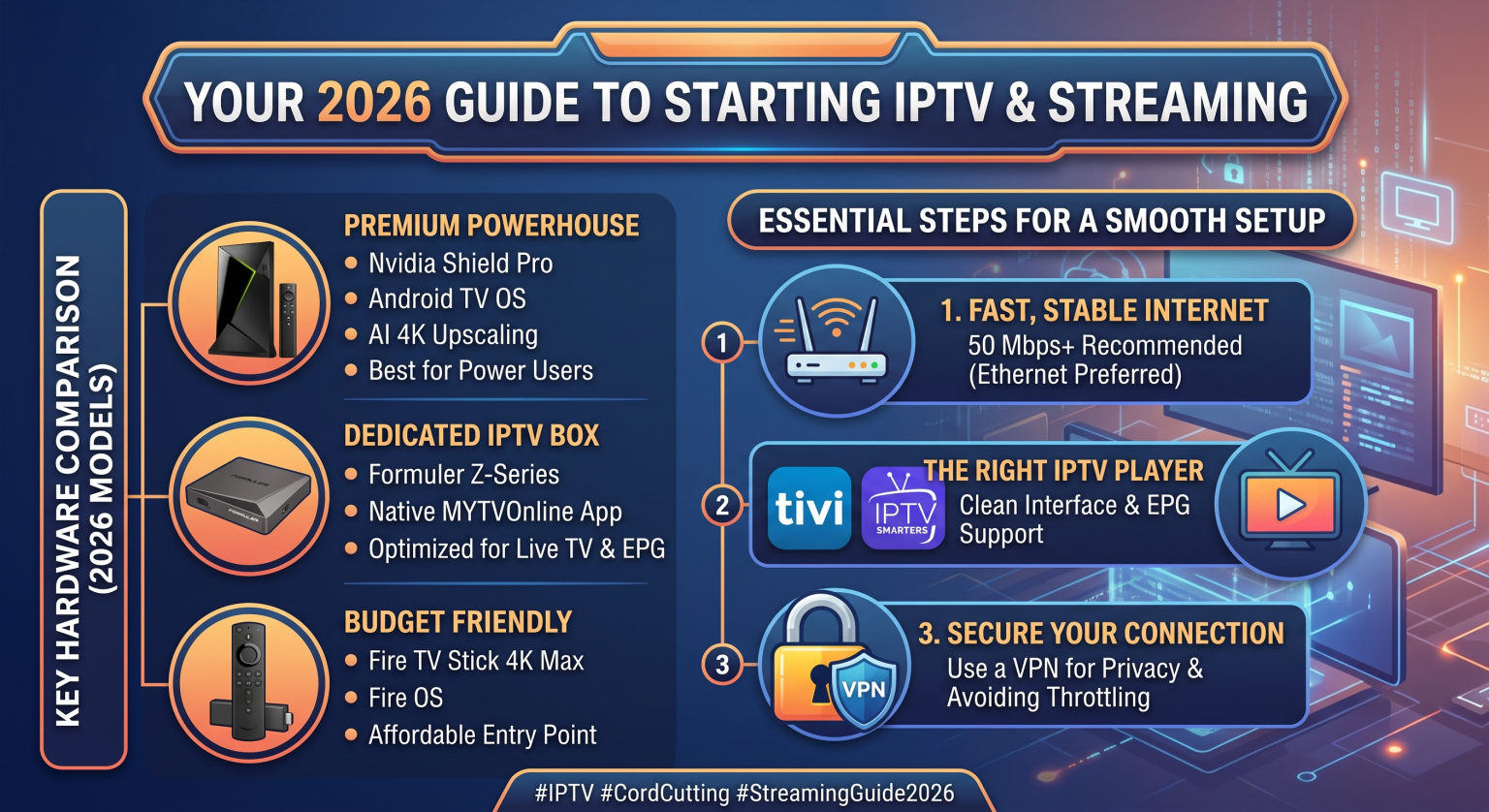
The Baseline: You need a stable 50 Mbps download speed just for your TV. If other people in the house are gaming or downloading files, you want 100 Mbps minimum.
Wired is King: Always use an Ethernet cable if you can. Wi-Fi is susceptible to interference from walls, microwaves, and your neighbor’s router.
Wi-Fi 6E: If you absolutely must use Wi-Fi, make sure your router and your streaming device support Wi-Fi 6 or 6E.
2. Choosing Your Hardware in 2026
The landscape of streaming devices shifted recently. The old reliable dongles are still around, but heavier, more capable boxes are taking over living rooms. Here is what is dominating the market right now.
The Heavyweight: Nvidia Shield TV Pro
Yes, the hardware has been around for a while, but Nvidia’s processor and AI upscaling remain undefeated. If you are watching 720p or 1080p IPTV streams, the Shield’s AI actually makes them look significantly sharper on your 4K TV. It is expensive, but it handles heavy apps, Plex servers, and Gigabit Ethernet speeds without breaking a sweat.
The IPTV Specialist: Formuler Z12 Ultra
If your primary goal is watching IPTV, Formuler is the brand to beat. The Z12 Ultra is custom-built for this exact purpose. It comes with Formuler’s proprietary software built-in, which flawlessly integrates your provider’s portal to feel exactly like a premium cable box. Channel zapping is instant, and the remote is built specifically for live TV navigation.
The Smart Home Hub: Google TV Streamer 4K
Google finally retired the hanging Chromecast dongles in favor of a sleek, set-top box design. It packs 32GB of storage, 4GB of RAM, and a built-in Gigabit Ethernet port. It is a massive upgrade for stability and app-loading speeds, though it lacks the raw upscaling power of the Shield or the dedicated IPTV software of the Formuler.
The Budget Pick: Amazon Fire TV Stick 4K Max (2nd Gen)
For secondary TVs or tight budgets, the Firestick 4K Max is still a solid choice. It supports Wi-Fi 6E and has enough power to run basic streaming apps smoothly. The catch? Amazon’s aggressive advertising on the home screen, and the fact that you usually have to sideload third-party IPTV-afspillere because they are not natively in the Amazon Appstore.
2026 Device Comparison Table
| Enhed | Bedst egnet til | OS Platform | Storage / RAM | Built-in Ethernet |
| Nvidia Shield TV Pro | Power users & Home Theater | Android TV | 16GB / 3GB | Yes (Gigabit) |
| Formuler Z12 Ultra | Dedicated IPTV Viewers | Android (Custom) | 32GB / 4GB | Yes (Gigabit) |
| Google TV Streamer 4K | General Streaming & Smart Home | Google TV | 32GB / 4GB | Yes (Gigabit) |
| Fire TV Stick 4K Max | Budget / Secondary TVs | Fire OS | 16GB / 2GB | No (Requires adapter) |
3. The Software That Makes It Work
Hardware is only half the battle. The app you use to play your streams dictates your entire daily experience.
TiviMate (Android Only): This is widely considered the gold standard for IPTV viewing. The interface is clean, it handles multiple playlists simultaneously, and the EPG integration is virtually flawless. The premium version is worth the upgrade for features like catch-up TV and recording.
IPTV Smarters Pro: Highly popular because it works on almost everything Android, iOS, Windows, and Samsung/LG smart TVs. It is user-friendly, making it great for beginners, though the interface isn’t quite as slick or customizable as TiviMate.
MYTVOnline (Formuler Exclusive): If you bought a Formuler box, you do not need third-party apps. This native software is deeply integrated with the hardware and offers the most authentic “cable-like” experience available on the market.
4. Privacy and Security First
You cannot talk about streaming without touching on network privacy. Depending on where your streams are originating, your Internet Service Provider (ISP) might decide to throttle your connection. If they detect heavy, sustained video traffic, they often dial back your speeds during peak hours, leading to buffering right in the middle of a crucial game.
Using a reputable VPN (Virtual Private Network) masks your traffic. Your ISP just sees encrypted data, which stops them from throttling your connection based on your specific activity. For the best results, install the VPN app directly on your streaming device and set it to auto-connect on boot.
Konklusionen
Getting your streaming setup right in 2026 isn’t about blindly buying the most expensive gear; it is about matching the hardware to how you actually watch TV.
If you want an all-in-one media powerhouse, grab the Nvidia Shield TV Pro. If you want the absolute best, lag-free IPTV experience with a classic remote control feel, the Formuler Z12 Ultra is your best bet. Fix your Wi-Fi, run an Ethernet cable if at all possible, install a clean user interface like TiviMate, and you will never miss that old cable bill again.