
Television technology changes rapidly. In 2026, Samsung offers two premium television technologies: Micro RGB and Mini LED. Micro RGB, also known as MicroLED, uses self-illuminating microscopic pixels. Mini LED uses a traditional liquid crystal display (LCD) panel with thousands of small backlight diodes. Buyers often want to know the differences between these two technologies before purchasing a new television. This article compares Samsung Micro RGB and Samsung Mini LED to explain how they work, how they perform, and which technology is better for different viewing situations.
Hurtigt svar
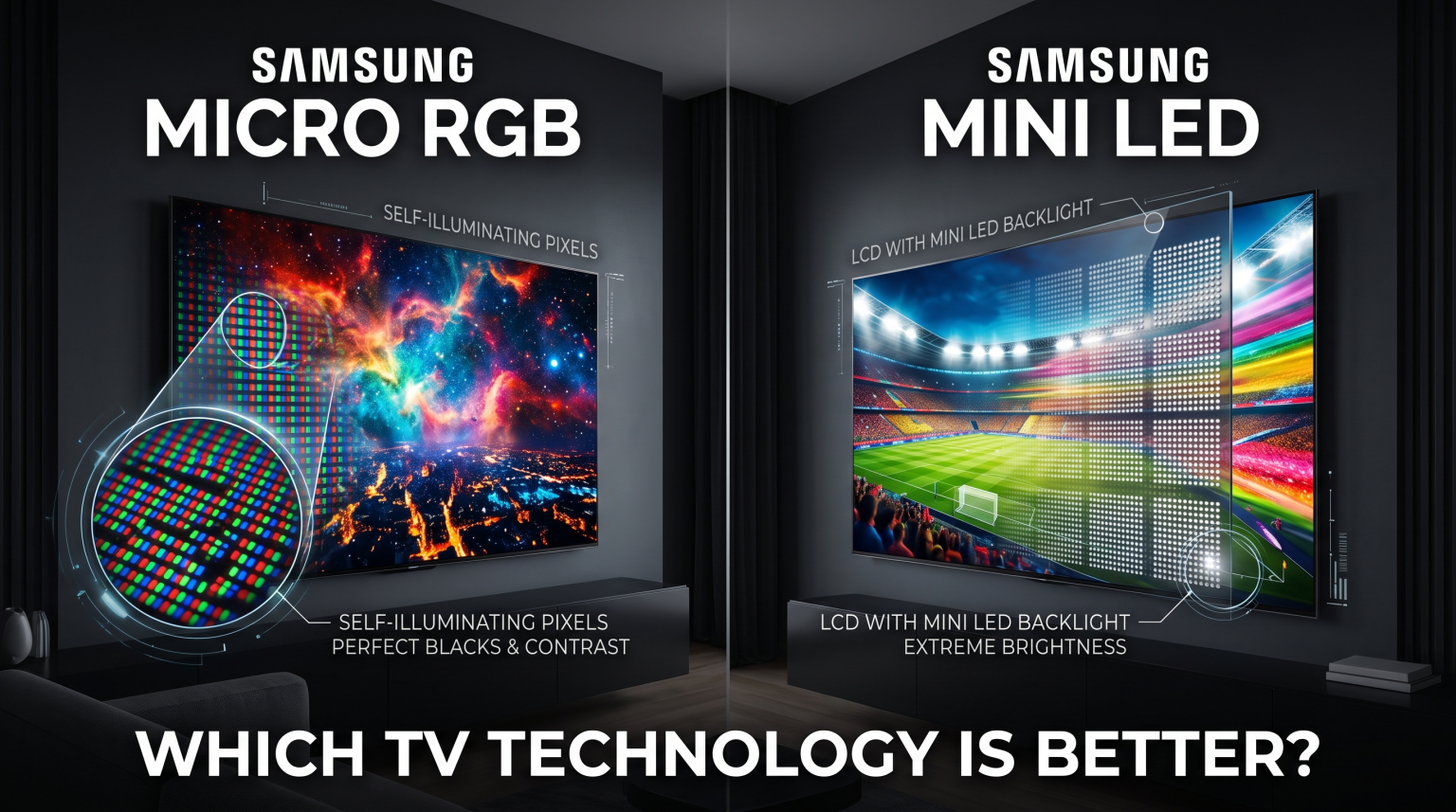
When comparing Samsung Micro RGB vs Mini LED, the better choice depends on your budget and room environment. Samsung Micro RGB provides superior picture quality. Micro RGB pixels create their own light, which allows for perfect contrast and black levels. However, Micro RGB televisions are very expensive and difficult to manufacture. Samsung Mini LED televisions are much more affordable. Mini LED televisions are exceptionally bright, making them excellent for rooms with large windows. Most consumers should buy a Mini LED television, while Micro RGB remains a luxury technology for dedicated home theaters.
How Samsung Mini LED Works
Samsung markets its Mini LED televisions under the “Neo QLED” brand name. A Mini LED television is an LCD television. The display requires a backlight to create an image.
Traditional LED televisions use large backlights. Mini LED televisions use thousands of microscopic backlights. Samsung groups these small backlights into dimming zones. The television processor turns these zones on and off independently. When a scene is dark, the television turns off the backlights in that area. This technology improves contrast.
Mini LED televisions also use a quantum dot layer. This layer improves color accuracy and color brightness.
How Samsung Micro RGB Works
Samsung Micro RGB is a different technology. Micro RGB does not use an LCD panel. Micro RGB does not use a backlight.
Instead, every single pixel on a Micro RGB television is made of three microscopic light-emitting diodes (red, green, and blue). Each pixel generates its own light and its own color. Because each pixel works independently, the television can turn off individual pixels completely. This creates perfect black levels.
Micro RGB shares many benefits with OLED technology. However, Micro RGB uses inorganic materials. This means Micro RGB televisions do not suffer from permanent screen burn-in
Comparison: Samsung Micro RGB vs Mini LED
| Funktion | Samsung Micro RGB | Samsung Mini LED (Neo QLED) |
| Display Technology | Self-illuminating pixels | LCD with LED backlight |
| Backlight Type | No backlight needed | Thousands of miniature LEDs |
| Dimming Zones | Millions (per pixel) | Thousands (hardware zones) |
| Black Levels | Perfect | Fremragende |
| Maximum Brightness | Meget høj | Extremely High |
| Screen Burn-In Risk | Ingen | Ingen |
| Price Category | Ultra-premium (Luxury) | Mid-range to Premium |
Picture Quality and Performance
Contrast and Black Levels
Micro RGB produces better contrast than Mini LED. Because Micro RGB pixels turn off completely, the screen can display true black colors next to bright white colors without light bleeding. Mini LED televisions have excellent contrast, but you may see a slight halo effect around bright objects on dark backgrounds.
Brightness
Mini LED televisions are currently the brightest televisions available. If you watch television in a room with direct sunlight, a Samsung Mini LED television will easily overcome screen reflections. Micro RGB is also very bright, but Mini LED generally achieves higher peak brightness measurements.
Viewing Angles
Micro RGB offers perfect viewing angles. You can sit anywhere in the room and the picture colors will look correct. Mini LED televisions lose color accuracy and contrast when you look at the screen from an extreme side angle.
Direkte fodbold- og sportsudsendelser
Watching live football requires specific television capabilities. Fast camera movements can cause motion blur.
Both Samsung Micro RGB and Mini LED handle motion very well. Both technologies offer 120Hz or 144Hz refresh rates. This high refresh rate keeps the football clear when the camera moves quickly across the pitch.
For weekend afternoon football matches, Mini LED is an excellent choice. The high brightness of the Mini LED backlight ensures the football pitch looks vibrant even in a sunlit room. If you want to compare other television types for sports, read our guide OLED kontra Mini-LED til direkte fodboldtransmissioner.
IPTV Compatibility and Smart TV Features
If you use TV Shadow IPTV, the television operating system is important. Both Samsung Micro RGB televisions and Samsung Mini LED televisions use the Samsung Tizen operating system.
Samsung Tizen provides access to the official Samsung App Store. You can download popular IPTV player applications directly from this store. Many of these applications support M3U playlists and Xtream Codes.
Because both television technologies use the same Tizen software, your IPTV experience will be identical regarding app installation, Electronic Program Guide (EPG) loading speeds, and remote-control usage. Ensure you connect your television directly to your internet router using an Ethernet cable for the most stable IPTV stream. For a broader look at television brands, read our comparison of the De bedste Smart-tv’er til IPTV i 2026: Sammenligning af Samsung, Sony, LG og TCL].
Konklusion
The debate between Samsung Micro RGB vs Mini LED comes down to technological maturity and price. Samsung Micro RGB is the superior display technology. It offers the perfect contrast of OLED combined with high brightness and zero burn-in risk. However, Micro RGB prices remain too high for average buyers. Samsung Mini LED represents the most logical choice for most people in 2026. Mini LED provides outstanding brightness, fantastic color performance, and excellent motion handling for live football and IPTV streaming, all at a reasonable price point.
Ofte stillede spørgsmål
Which technology is more expensive, Micro RGB or Mini LED?
Micro RGB is significantly more expensive. Manufacturing microscopic self-illuminating pixels is a complex process. Mini LED is a mass-market technology and is much more affordable for normal consumers.
Do Mini LED televisions suffer from screen burn-in?
No. Mini LED televisions use LCD panels and standard LED backlights. These materials are inorganic and do not suffer from permanent image retention or screen burn-in.
Do Micro RGB televisions suffer from screen burn-in?
No. Unlike OLED televisions, Micro RGB televisions use inorganic materials. You can display static images, such as news channels or sports scores, without risking screen damage.
Is Mini LED the same as OLED?
No. Mini LED uses an LCD screen with a backlight. OLED uses self-illuminating pixels. Micro RGB is much closer to OLED technology than Mini LED is.
Can I install IPTV applications on Samsung Mini LED TVs?
Yes. Samsung Mini LED televisions use the Tizen operating system. You can download compatible IPTV player applications from the built-in Samsung App Store.