
The UEFA Champions League has undergone its most significant structural change in decades. Moving away from the traditional four-team group stage, the tournament now uses a single massive league table featuring 36 clubs. This updated system has naturally led to many questions from football fans about how the Champions League qualification format actually works.
There are two major stages of qualification to understand. First, you need to know how 36 clubs secure their tickets to enter the competition. Second, you must understand how teams qualify out of the new league phase to reach the prestigious knockout rounds. This guide breaks down both processes clearly, ensuring you know exactly what your favorite team needs to do to survive and advance.
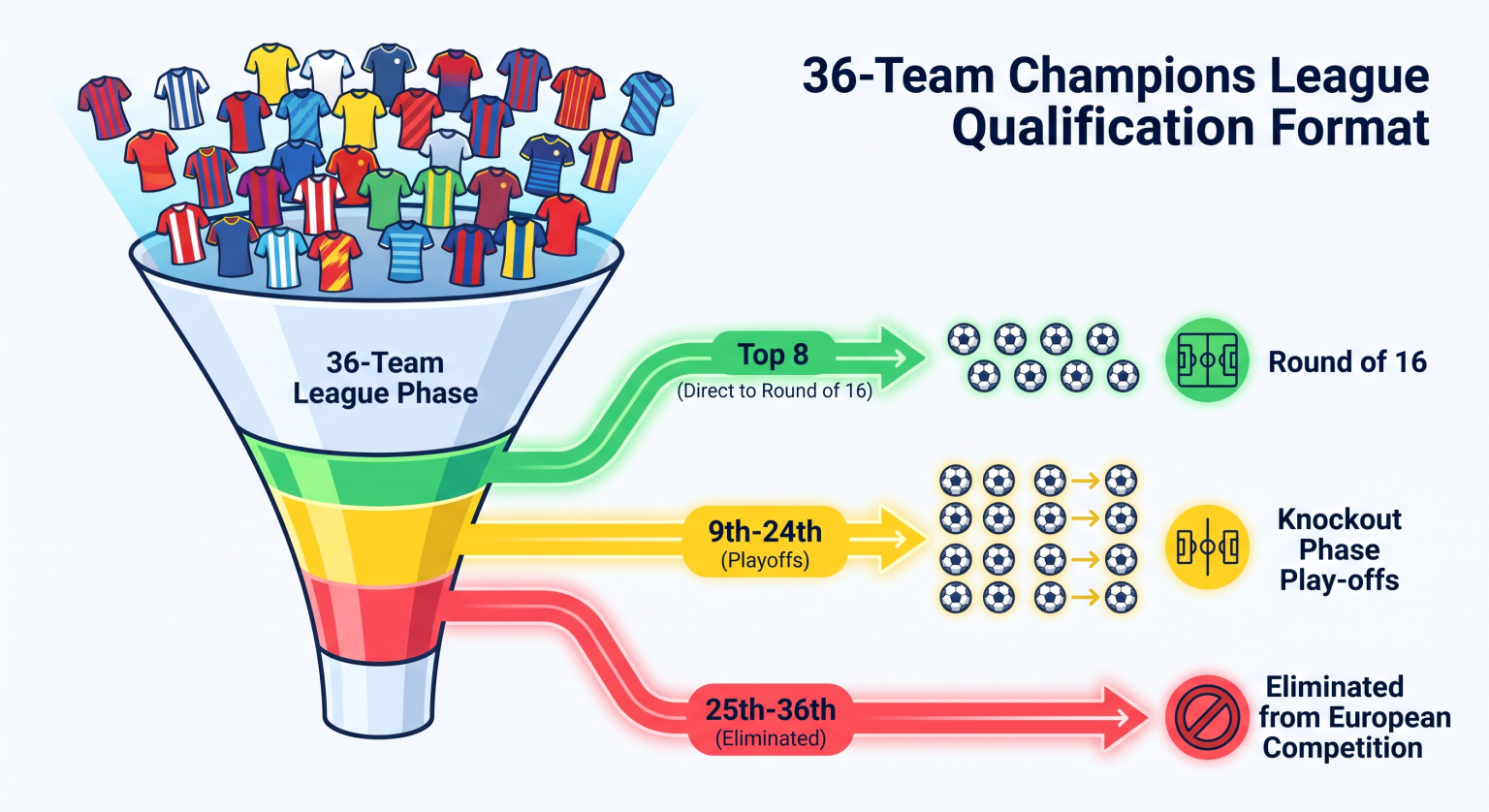
Direct Answer: In the 36-team Champions League format, qualification operates on two levels. First, teams qualify for the tournament itself through high domestic league finishes, qualifying playoff rounds, or the newly introduced European Performance Spots (EPS). Second, once inside the tournament’s single-league phase, the top eight teams qualify directly for the Round of 16. Teams finishing 9th through 24th must compete in a two-legged playoff to claim the remaining eight knockout spots, while teams finishing 25th to 36th are completely eliminated from European competition.
Earning a Spot: How Teams Qualify for the 36-Team Tournament
The expansion from 32 to 36 teams meant UEFA had to distribute four additional golden tickets. Under the current Champions League qualification format, reaching the main tournament remains heavily dependent on domestic success, but historical and collective league performance now play a larger role.
If you are following the broader context of the tournament, you can check our comprehensive Champions League guide for complete details on the competition’s history and scheduling.
Standard Domestic League Qualification
The core of the tournament remains unchanged: the best teams from Europe’s strongest leagues qualify automatically. The number of guaranteed spots a country receives depends on its UEFA coefficient ranking.
Top Four Leagues: Countries like England, Spain, Germany, and Italy typically receive four automatic spots for the teams finishing at the top of their domestic tables.
Next Tier Leagues: Countries ranked slightly lower, such as France or the Netherlands, receive fewer automatic spots, usually two or three.
Lower Ranked Leagues: Smaller footballing nations may only receive one spot, which requires their national champion to navigate multiple grueling qualifying rounds before reaching the league phase.
The European Performance Spots (EPS)
Two of the four newly added spots are awarded through a system called European Performance Spots. This system rewards the two national leagues whose clubs achieved the best collective performance across all UEFA competitions in the previous season.
For example, if Italian and German clubs perform exceptionally well in the Champions League, Europa League, and Conference League during one season, the fifth-placed teams in Serie A and the Bundesliga will receive a bonus entry into the following season’s Champions League. This system ensures that the most competitive leagues are rewarded, but the spots change hands every year based on fresh results.
The Extra Coefficient Spot and Champions Path
The remaining two extra spots are distributed to ensure a balance between elite leagues and smaller nations:
Fifth-Ranked Nation Bonus: One additional spot goes to the third-placed team in the league ranked fifth in the UEFA coefficient (historically France).
The Champions Path: The final additional spot is added to the “Champions Path” of the qualifying rounds. This means five domestic champions from smaller European leagues can now survive the summer qualifying rounds to reach the main tournament, up from four in previous years.
Surviving the League Phase: How Knockout Qualification Works
Once the 36 teams enter the main competition, the traditional group stage is gone. Instead, all 36 clubs are placed into one giant league table. Every team plays eight matches against eight different opponents (four games at home and four games away).
This is where the second phase of the Champions League qualification format takes over. To read more about how these specific fixtures are drawn, see our previous article on the Swiss-system draw mechanics.
The Top 8: Direct Qualification
The ultimate goal during the league phase is to finish in the top eight of the massive 36-team table.
The Reward: Teams ranked 1st through 8th bypass the perilous playoff round.
The Advantage: They qualify directly for the Round of 16 and receive a crucial rest period in February while the other teams battle in playoffs. Furthermore, these top eight teams will be seeded in the Round of 16 draw, meaning they are guaranteed to play the second leg of their knockout tie at home.
Ranks 9 to 24: The Playoff Round
Clubs that finish between 9th and 24th place enter a tense two-legged knockout playoff round to keep their European dreams alive.
The Seeded Teams (9th–16th): These teams have a major advantage. They are seeded for the playoff draw and will play the crucial second leg of their playoff tie at home.
The Unseeded Teams (17th–24th): These teams must play the second leg away from home.
The eight winners of these playoff ties will advance to the Round of 16, where they will face one of the top eight teams. Once the Round of 16 is set, the tournament progresses with standard two-legged knockout ties until the single-match final. For a deeper look at the later stages, check our next article on the road to the Champions League final.
Ranks 25 to 36: Complete Elimination
Under the old format, teams finishing third in their four-team groups were demoted to the UEFA Europa League. That safety net no longer exists.
If a team finishes 25th or lower in the 36-team league phase, their European season is completely over. There is no drop-down to the Europa League or the Conference League. This raises the stakes significantly for every single match during the league phase, as even heavy defeats can ruin a team’s goal difference and push them into the elimination zone.
Troubleshooting Your Viewing Experience
As the competition format changes, the number of broadcasted matches increases significantly. At TV Shadow IPTV, we want to ensure you have a smooth viewing experience on your local licensed sports networks. Here are some quick troubleshooting steps if you have trouble finding a match:
Why can’t I find the Champions League match?
With 36 teams playing eight matches each, there are many more fixtures, sometimes spread across Tuesdays, Wednesdays, and exclusive Thursday matchdays.
Check the Kickoff Time: Confirm the time zone. UEFA schedules matches at two primary time slots. Convert CET (Central European Time) to your local time to ensure you haven’t missed kickoff.
Verify the Broadcaster: Broadcasting rights change frequently. Ensure you are looking at the official licensed broadcaster for your specific country. TV Shadow IPTV advises always using your regional licensed sports channels (such as TNT Sports, CBS Sports, DAZN, or Canal+) to watch matches legally.
Update Your EPG: If your Electronic Program Guide is blank, refresh or reload your IPTV app data to fetch the latest TV guide schedules.
Check Your Network: High-definition sports streams require a stable internet connection. If your picture buffers, restart your router or connect your streaming device directly via an Ethernet cable.
Conclusion
The updated 36-team Champions League qualification format was designed to bring more high-stakes matches and diverse matchups to football fans around the world. By replacing the small group stages with a single massive league, UEFA has ensured that every goal, every point, and every draw matters from September all the way to January.
Whether your team is aiming for a top-eight automatic qualifying spot or fighting for survival in the playoff places, the margins for error have never been slimmer. Keep your streaming setups optimized, check your local broadcasting schedules, and enjoy a thrilling era of European football.
Frequently Asked Questions
Do teams still drop down to the Europa League?
No. Under the new 36-team Champions League qualification format, teams that finish 25th through 36th in the league phase are completely eliminated from all European competitions for the season.
How many matches does a team need to win to reach the top 8?
Because the format is relatively new, exact point thresholds can vary. However, analysts estimate that securing around 15 to 17 points (five wins, or four wins and three draws) from the eight matches should be enough to guarantee a top-eight finish.
What happens if teams finish on equal points in the league phase?
If two or more teams are tied on points, UEFA uses a strict set of tiebreakers. Because teams do not play the exact same opponents, overall goal difference in the league phase is the primary tiebreaker, followed by total goals scored.
Are the knockout stages also a league format?
No. Once the league phase and the playoff round are completed, the competition reverts to a traditional knockout bracket starting from the Round of 16. Teams play two-legged ties (home and away) until the single-match final.
What are European Performance Spots?
These are two extra places awarded to the domestic leagues that performed the best across all European club competitions in the previous season. The clubs that finish just outside the standard qualification places in those two successful leagues receive the bonus spots.