
The Alliance for Open Media (AOMedia) finalized the AV2 video codec specification in May 2026. This new technology will eventually replace the older AV1 video codec for digital video distribution. For 4K streaming, video codecs control picture quality and data consumption over the internet. The AV1 codec is currently the standard format for modern television streaming. The AV2 codec introduces new compression methods to reduce file sizes further.
Because 4K video contains millions of pixels, streaming 4K video requires efficient data compression. Uncompressed 4K video would overload internet connections immediately. Video codecs solve this problem by shrinking the video data before transmission. Understanding the differences between the AV2 codec and the AV1 codec helps users choose the right Smart TV hardware. This article explains how the transition from AV1 to AV2 will affect 4K streaming, Smart TV compatibility, and live sports viewing.
Réponse rapide
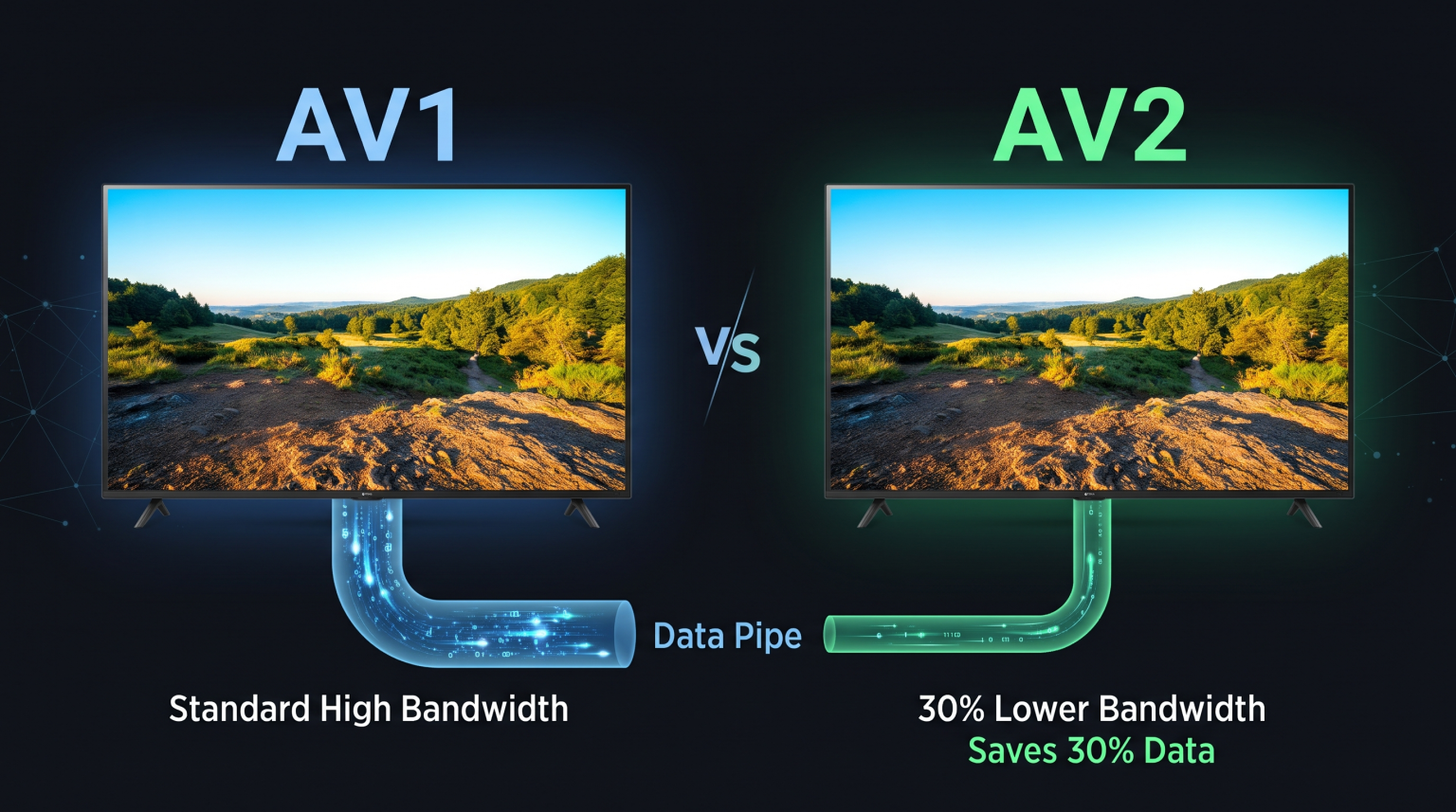
The AV1 codec is the best practical choice for 4K streaming in 2026. Almost all modern Smart TVs include hardware decoders for the AV1 codec. The AV2 codec offers approximately 30 percent better data compression than the AV1 codec. However, the AV2 codec currently lacks hardware support on consumer televisions. Streaming platforms will adopt the AV2 codec in the future to reduce bandwidth costs. For now, viewers should buy televisions with strong AV1 hardware support for immediate 4K streaming stability.
What Are AV1 and AV2 Video Codecs?
A video codec is software or hardware that compresses and decompresses digital video. The word “codec” stands for coder-decoder.
When a streaming service sends a movie to your television, the service uses a codec to compress the massive video file. When the television receives the file, the television uses the same codec to decompress the video for display.
The Alliance for Open Media (AOMedia) develops both the AV1 and AV2 codecs. AOMedia is a consortium of technology companies, including Google, Amazon, and Netflix. These companies created these codecs to provide high-quality video compression without charging royalty fees.
The AV1 codec was released in 2018. The AV1 codec is now a mature technology with widespread hardware support. The AV2 codec is the successor to the AV1 codec. The AV2 codec defines a completely new decoding process to achieve better efficiency.
AV2 vs AV1: Technical Differences
The main difference between the two codecs is compression efficiency. Compression efficiency measures how much data a codec needs to display a specific level of picture quality.
The AV2 codec is significantly more efficient than the AV1 codec. Recent tests show that the AV2 codec achieves about 30 percent lower data rates than the AV1 codec while maintaining the exact same picture quality. This means a 4K video encoded with AV2 requires 30 percent less internet bandwidth than the same 4K video encoded with AV1.
However, this high efficiency requires massive computing power. Encoding a video with the AV2 codec currently takes much longer than encoding a video with the AV1 codec. Decoding the AV2 video also requires more processing power from the television or streaming device.
Décodage matériel vs décodage logiciel
Televisions decode video using either hardware or software.
Hardware decoding uses a dedicated microchip inside the television. Hardware decoding is fast, smooth, and uses very little electricity.
Software decoding uses the television’s main processor. Software decoding is slow, causes heat, and often results in stuttering video during 4K playback.
In 2026, almost all new Smart TVs have hardware decoding for the AV1 codec. No current Smart TVs have hardware decoding for the AV2 codec. Until television manufacturers build AV2 hardware chips, televisions must use software decoding for AV2 video. Software decoding is usually not powerful enough for smooth 4K AV2 playback.
AV1 and AV2 Feature Comparison
| Fonctionnalité | AV1 Codec | AV2 Codec |
| Release status | Released in 2018 | Finalized in May 2026 |
| Compression efficiency | Élevé | Very High (30% better than AV1) |
| Bandwidth needed for 4K | Moyen | Faible |
| Hardware TV support | Wide support on modern TVs | No current native support |
| Decoding power needed | Low (with hardware chip) | Very High (currently software) |
| Promoteur | Alliance for Open Media | Alliance for Open Media |
| Royalty fees | Royalty-free | Royalty-free |
Smart TV Compatibility in 2026
The operating system and hardware of a Smart TV determine which codecs the television can play smoothly.
Samsung Tizen
Samsung televisions use the Tizen operating system. Modern Samsung Smart TVs provide excellent hardware support for the AV1 codec. Users can stream 4K AV1 video smoothly on recent Samsung models. Samsung has not yet announced which future television models will include hardware decoders for the AV2 codec.
Sony BRAVIA and Google TV
Sony BRAVIA televisions use the Google TV operating system. Sony televisions also include robust hardware decoders for the AV1 codec. Google is a founding member of AOMedia. Google strongly supports AV1 across the Google TV app ecosystem. Google plans to support the AV2 codec in the future, but current Sony BRAVIA hardware cannot decode AV2 efficiently in 4K.
LG webOS
LG televisions use the webOS operating system. Recent LG OLED and LG QNED televisions fully support hardware decoding for the AV1 codec. This makes LG televisions very capable for current 4K streaming. Similar to Samsung and Sony, LG televisions currently lack the dedicated hardware chips required for AV2 decoding.
Users who want to understand more about television operating systems can read our guide to Meilleur système d'exploitation pour Smart TV dédié à l'IPTV en 2026.
What AV2 Means for TV Shadow IPTV and Streaming Apps
IPTV services deliver live television and video-on-demand over the internet. Users access TV Shadow IPTV using IPTV player applications. Popular applications include TiviMate, IPTV Smarters Pro, and XCIPTV.
IPTV player applications rely on the television’s internal hardware to decode video streams. If a user enters an M3U playlist or Xtream Codes login into an IPTV app, the app requests the video stream. When the stream arrives, the television hardware must process the codec.
Currently, television channels and video-on-demand files use H.264, H.265 (HEVC), or AV1 codecs. Modern Smart TVs decode these formats easily. TV Shadow IPTV does not limit which television you can use, provided your television can run a compatible IPTV application and decode the incoming video formats.
When streaming providers eventually switch to the AV2 codec, IPTV users will experience several benefits:
Less Buffering: Because the AV2 codec requires 30 percent less data, users with slow internet connections will experience fewer interruptions.
Better Picture Quality: At the same internet speed, the AV2 codec can deliver sharper 4K images than the AV1 codec.
Faster Channel Loading: Smaller data segments allow IPTV applications to load live channels faster.
However, these benefits will only apply when users upgrade to future streaming devices or Smart TVs that contain AV2 hardware decoders. For now, the AV1 codec remains the most efficient and reliable format for IPTV streaming. If you experience visual issues on your current setup, you can learn more in our article about Pourquoi l'IPTV est-elle floue sur un téléviseur 4K neuf ?.
AV2 vs AV1 for Live Football and Sports Streaming
Live football and fast-paced sports require excellent video processing. Sports broadcasts feature constant camera movement, running players, and complex visual details like grass textures.
Motion Handling and Bitrate
When the camera pans quickly across a football pitch, the video codec must update almost every pixel on the screen. If the internet bandwidth is too low, the video codec will create visual artifacts. These artifacts look like blocky squares or blurry motion.
The AV1 codec handles fast motion much better than older formats like H.264. The AV1 codec maintains clear grass textures and sharp player numbers during fast camera movements.
The AV2 codec will handle motion even better. The advanced temporal filtering in the AV2 codec predicts motion accurately. This means the AV2 codec can maintain a sharp 4K sports broadcast at a much lower bitrate than the AV1 codec.
Refresh Rates and Network Stability
A television’s refresh rate (measured in Hertz or Hz) also affects sports viewing. A 120Hz television can display fast action more smoothly than a 60Hz television. However, the refresh rate cannot fix a poor video stream. The video codec and the internet connection determine the quality of the stream.
For the best live football experience in 4K, users should connect their Smart TV directly to their internet router using an Ethernet cable. An Ethernet cable provides a more stable connection than Wi-Fi. A stable connection ensures the video codec receives a constant flow of data, which prevents buffering during important sports moments.
When Will Streaming Platforms Use the AV2 Codec?
The transition to a new video codec takes many years. The AV1 codec was released in 2018, but major streaming platforms took several years to implement AV1 fully.
The AV2 codec will follow a similar timeline. Early reports suggest that YouTube might begin testing AV2 video streams on desktop computers in 2027. Desktop computers can use software decoding through web browsers like Google Chrome.
For Smart TVs and mobile phones, the transition will take longer. Hardware manufacturers must design new microchips. Then, television brands must include these chips in new television models. Finally, consumers must buy the new televisions.
Therefore, the AV1 codec will remain the primary format for 4K streaming and IPTV for several more years. The AV2 codec is the technology of the future, but the AV1 codec is the technology of today.
Conclusion
The evolution from the AV1 video codec to the AV2 video codec represents an important improvement for 4K streaming. The AV2 codec will eventually reduce internet bandwidth requirements by 30 percent. This reduction will lower buffering rates and improve picture quality for live sports and on-demand video.
However, the AV2 codec requires new hardware that does not exist in 2026 consumer televisions. Because software decoding is too slow for 4K streaming, viewers cannot use the AV2 codec on their current devices. For the next few years, the AV1 codec will remain the most practical and widely supported format. Users who use applications with TV Shadow IPTV will get the best results by using modern Smart TVs that feature strong AV1 hardware decoding.
Ajoutez ici le texte de votre titre
Is the AV2 codec better than the AV1 codec?
Yes, the AV2 codec is technically superior. The AV2 codec compresses video approximately 30 percent more efficiently than the AV1 codec. This efficiency saves internet bandwidth and improves 4K picture quality.
Can my current Smart TV play AV2 video?
No, current Smart TVs cannot play AV2 video efficiently. The AV2 codec requires dedicated hardware decoding chips. Televisions manufactured in 2026 do not include AV2 hardware chips.
Will TV Shadow IPTV support the AV2 codec?
TV Shadow IPTV delivers streams to your chosen IPTV application. The ability to play a specific codec depends entirely on your television hardware and your IPTV player application, not the IPTV provider.