
Si, en consultant votre facture mensuelle de câble, vous vous demandez pourquoi vous payez un supplément pour des chaînes que vous ne regardez jamais, vous n’êtes pas le seul. Des millions de Canadiens se détournent du câble cette année pour passer à la télévision par protocole Internet (IPTV).
Mais trouver le à droite Service IPTV Au Canada, en 2026, c'est un peu comme dans le Far West. Une simple recherche inondera votre écran de centaines de fournisseurs, qui prétendent tous proposer un “ streaming 4K sans mise en mémoire tampon ” et des “ chaînes illimitées ”. La réalité ? Beaucoup d'entre eux font des promesses exagérées, ne tiennent pas leurs engagements et disparaissent au bout de quelques mois.
Que vous souhaitiez ne manquer aucun match de la LNH, regarder en rafale des séries internationales ou simplement profiter d'un service de streaming fiable sans vous ruiner, ce guide vous expliquera en détail ce qu'il faut rechercher et comment rester dans la légalité tout en assurant votre sécurité.
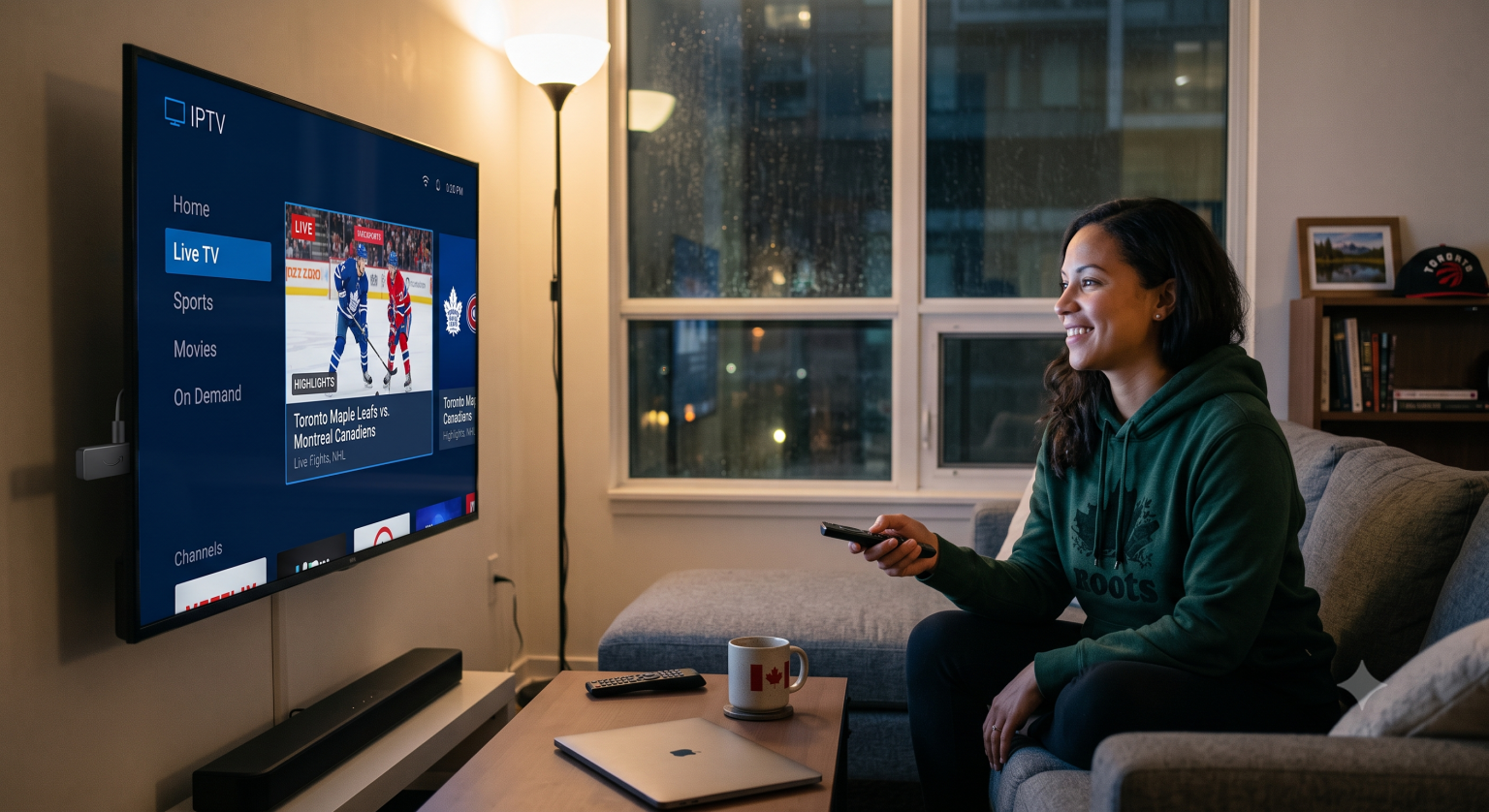
Pourquoi passer à l'IPTV en 2026 ?
Le câble traditionnel, bien que fiable, est rigide. Vous payez des forfaits groupés, louez des décodeurs encombrants et êtes généralement lié par des contrats. L'IPTV change complètement la donne en diffusant les contenus télévisés directement via votre connexion Internet.
Voici pourquoi les ménages canadiens franchissent le pas :
Liberté matérielle : Vous n'avez pas besoin d'un décodeur propriétaire. L'IPTV fonctionne sur les appareils que vous possédez déjà. Amazon Firesticks, les téléviseurs connectés (Samsung, LG, Android TV), les Apple TV et même votre smartphone.
Intégration à la demande : Les meilleurs services associent harmonieusement la télévision en direct (comme les actualités locales et les événements sportifs en direct) à de vastes catalogues de vidéo à la demande (VOD), fonctionnant à la fois comme une télévision classique et comme Netflix.
Maîtrise des coûts : Dites adieu aux frais de location de matériel et aux contrats à long terme obligatoires.
Quels sont les critères essentiels à prendre en compte lors du choix d'un fournisseur d'IPTV ?
Si vous avez déjà passé un peu de temps sur Reddit ou sur des forums consacrés au streaming, vous avez sans doute remarqué que certains utilisateurs se plaignent que les diffusions s’interrompent en plein milieu d’un match important. Lorsque vous évaluez un service, ne vous laissez pas impressionner par les promesses tape-à-l’œil du type “ 50 000 chaînes ”. La qualité l’emporte toujours sur la quantité.
Voici les quatre indicateurs que vous devez réellement vérifier :
1. Disponibilité et stabilité aux heures de pointe
Un service peut fonctionner parfaitement un mardi après-midi, mais que se passe-t-il pendant les séries éliminatoires de la Coupe Stanley, lorsque des milliers d’utilisateurs se connectent simultanément ? Recherchez des fournisseurs qui mettent en avant l“” équilibrage de charge » ou qui ont fait leurs preuves en matière de disponibilité à 99,1 % (TP8T). Si un fournisseur propose un essai de 24 heures, activez-le un samedi soir pour tester ses serveurs en situation de forte charge.
2. Configuration requise pour la 4K véritable
De nombreux services prétendent offrir une qualité 4K, mais ils compressent fortement le flux vidéo afin d'économiser la bande passante du serveur. La véritable 4K Ultra HD nécessite une connexion Internet stable. En règle générale, il faut disposer d'un débit minimum constant et clair d'au moins 25 Mbps de bande passante pour profiter d'un streaming 4K fluide. Si votre connexion Internet à domicile ne dépasse pas les 15 Mbps, optez plutôt pour un streaming HD 1080p stable afin d'éviter la redoutable roue de chargement.
3. Guide électronique des programmes (EPG)
Une liste de chaînes très longue ne sert à rien si vous ne pouvez pas y naviguer. Un guide électronique des programmes (EPG) performant et régulièrement mis à jour vous offre une expérience IPTV comparable à celle d'un abonnement au câble haut de gamme. Il vous indique précisément ce qui est diffusé et ce qui va suivre.
4. Télé à la demande
Cette fonctionnalité change la donne. La fonction “ Catch-up ” vous permet de remonter dans le guide des programmes et de regarder des émissions ou des événements sportifs en direct diffusés plus tôt dans la semaine ; elle fait en quelque sorte office de magnétoscope numérique dans le cloud sans occuper d'espace de stockage sur votre appareil.
Le contexte juridique : l'IPTV est-elle légale au Canada ?
C'est l'une des questions les plus fréquemment posées, et il circule beaucoup d'informations erronées à ce sujet.
La réponse en bref : La technologie IPTV est légale selon la norme 100%.
Regarder des contenus télévisés en streaming sur Internet, c'est exactement ce que vous faites lorsque vous regardez Netflix ou Crave. La distinction entre ce qui est légal et ce qui ne l'est pas repose entièrement sur octroi de licences.
En vertu de la Loi sur le droit d’auteur du Canada et des règlements du CRTC, tout service diffusant du contenu télévisuel aux Canadiens doit détenir les licences nécessaires pour diffuser ce contenu.
IPTV légale et conforme aux exigences du CRTC : Des fournisseurs tels que Bell Fibe TV, Rogers Ignite TV et Shaw BlueCurve sont, techniquement parlant, des services IPTV. Ils diffusent du contenu via IP, détiennent toutes les licences nécessaires et sont tout à fait légaux. De même, des plateformes telles que Crave, Sportsnet+ et Netflix Canada opèrent en totale conformité avec la loi.
Services tiers non agréés : Il existe un vaste marché parallèle composé de vendeurs tiers (que l'on retrouve souvent dans des groupes Facebook ou sur des forums) proposant des milliers de chaînes internationales, des événements sportifs haut de gamme et des événements à la carte pour des abonnements mensuels incroyablement bas. Ces services ne rémunèrent généralement pas les titulaires de droits. Bien que la GRC s’en prenne rarement aux diffuseurs individuels, votre fournisseur d’accès à Internet (FAI) peut vous envoyer des avertissements dans le cadre du régime canadien de “ notification et notification ” si les détenteurs de droits signalent votre adresse IP pour diffusion non autorisée de contenus protégés par le droit d’auteur.
Si vous accordez la priorité à la sécurité, à la fiabilité et au respect garanti de la législation, le mieux est de vous tourner vers des diffuseurs canadiens titulaires d'une licence du CRTC proposant un service de streaming sur IP.
Comment optimiser l'aménagement de votre logement
Même le meilleur service IPTV le son sera saccadé si votre réseau domestique n'est pas optimisé. Si vous souhaitez profiter d'une expérience sans mise en mémoire tampon, suivez ces règles d'or :
Tout câbler : Le Wi-Fi est pratique, mais il est sensible aux interférences provenant des murs, des micro-ondes et même des réseaux de vos voisins. Si possible, branchez un câble Ethernet directement entre votre routeur et votre appareil de streaming (comme votre Apple TV ou votre box Android).
Investissez dans un bon VPN : Si vous utilisez des services internationaux ou tiers, il est fortement recommandé d'utiliser un réseau privé virtuel (VPN). Cela empêche votre FAI de limiter votre débit s'il détecte un trafic important lié au streaming vidéo, ce qui garantit une connexion plus fluide aux heures de pointe.
Choisissez le bon joueur : Ne vous fiez pas à des applications génériques et peu pratiques. Si vous utilisez un appareil sous Android ou une Firestick, des applications comme TiviMate ou IPTV Smarters Pro proposent les meilleures interfaces utilisateur, facilitant la gestion des listes de lecture, des favoris et de votre guide électronique des programmes (EPG).
En résumé
Pour trouver la meilleure offre IPTV au Canada, il faut avant tout déterminer ce qui compte le plus pour vous. Si vous recherchez une expérience légale de type « 100% », où il suffit de configurer le service une fois pour toutes, les offres IPTV des grands opérateurs de télécommunications canadiens sont extrêmement fiables et faciles à utiliser.
Si vous envisagez d'autres solutions Fournisseurs d'IPTV, renseignez-vous bien. Privilégiez la stabilité plutôt que le nombre de chaînes, exigez toujours une période d'essai avant de vous engager dans un abonnement de 12 mois, et assurez-vous que le débit de votre connexion Internet à domicile est suffisant.