
The television market in 2026 offers two excellent choices for premium viewers: the Roku Pro LX OLED and the Samsung OLED series. Both televisions use advanced OLED panel technology to display perfect black levels and infinite contrast. However, they use completely different operating systems and offer different smart TV features. The Roku Pro LX OLED runs the proprietary Roku OS and focuses on a simple user experience. Samsung OLED models, such as the 2026 Samsung S95H, run the Tizen operating system and offer deep integration with the Samsung app ecosystem.
Choosing between a Roku Pro LX OLED and a Samsung OLED requires understanding how you will use the television. Users must consider app availability, external device connectivity, picture processing, and gaming specifications. For users who stream live television or use internet protocol television services, the operating system is the most important factor. This article explains the technical differences between the Roku Pro LX vs Samsung OLED to help you choose the best television for your needs.
Réponse rapide
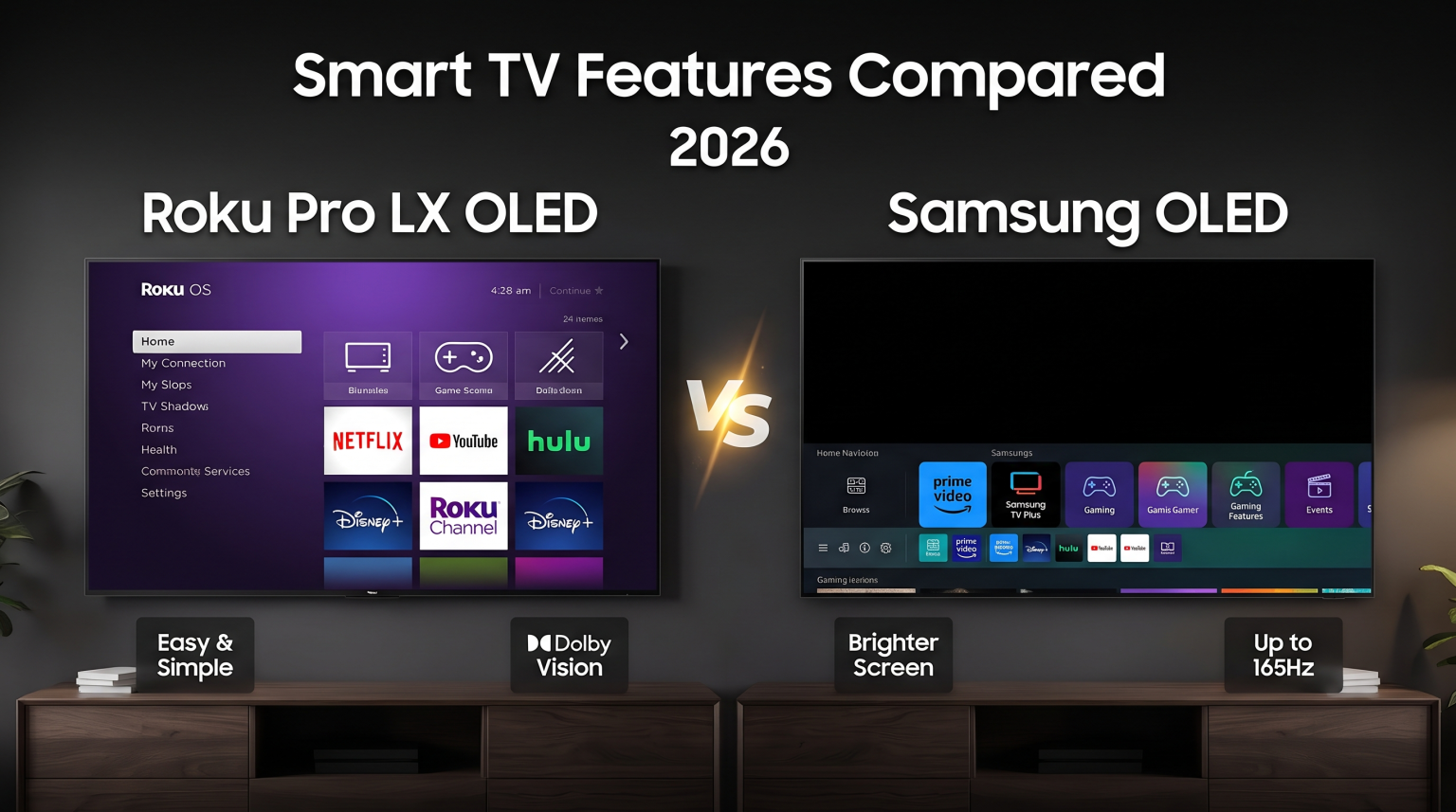
The Roku Pro LX OLED is suitable for users who want a very simple menu interface, Dolby Vision support, and fast gaming response times. It uses Roku OS, which is easy to navigate but limits third-party application installation.
The Samsung OLED is suitable for users who want brighter screen technology, superior screen reflection handling, and PC gaming support up to 165Hz. It uses Samsung Tizen, which offers a larger official app store and better support for specialized media players. Neither television supports native Android applications.
Operating System and App Store
The operating system controls how you interact with your television every day. The Roku Pro LX OLED uses Roku OS. This system uses a simple grid of applications on the home screen. Roku OS is very easy to learn. It responds quickly when you press buttons on the remote control. However, the Roku channel store is heavily controlled by the manufacturer. Roku restricts many unofficial or independent applications from its platform.
Samsung OLED televisions use the Tizen operating system. Tizen uses a navigation bar at the bottom or side of the screen. The Tizen interface is more complicated than Roku OS. It offers more customization options and smart home features. The Samsung App Store is also strictly controlled, but it generally offers a wider variety of utility applications and media players than Roku OS. If you are comparing television operating systems, our guide to Meilleur système d'exploitation pour Smart TV dédié à l'IPTV en 2026] explique les différences entre Tizen, Google TV et webOS.
IPTV Application Availability
Because this article is for TV Shadow IPTV users, we must discuss IPTV compatibility. Smart TV operating systems severely limit which IPTV players you can install.
The Roku Pro LX OLED is very restrictive for IPTV viewing. Roku OS does not support native M3U playlist players or Xtream Codes applications. Roku actively removes most third-party IPTV players from its channel store. If you buy the Roku Pro LX OLED for IPTV, you will almost certainly need to connect an external streaming device, such as an Android TV stick, to an HDMI port.
Samsung OLED televisions provide a better native experience for IPTV users. The Samsung Tizen app store includes several popular IPTV players. You can find dedicated applications that support M3U playlists and Electronic Program Guides (EPG). However, Samsung Tizen still does not support Android APK files. Therefore, you cannot install Android-specific IPTV applications on a Samsung OLED. You must use only the applications available in the official Samsung store.
Picture Quality and HDR Support
Both televisions use OLED technology. This means every pixel creates its own light. Both televisions turn off individual pixels to create perfect black colors.
The Roku Pro LX OLED introduces a brighter panel compared to previous Roku models. It includes an antireflective coating to reduce room glare. The Roku Pro LX OLED supports multiple High Dynamic Range formats, including HDR10, HDR10+, and Dolby Vision. Dolby Vision is very popular on streaming services like Netflix.
The 2026 Samsung OLED models, such as the S95H, offer incredibly bright screens. Independent tests show that the Samsung S95H handles room reflections slightly better than the Roku OLED. However, Samsung does not support Dolby Vision. Samsung OLED televisions support HDR10 and HDR10+.
Diffusion en direct de matchs de football et d'autres événements sportifs
Watching live football requires a television with excellent motion handling. Fast camera movements can look blurry on cheap televisions.
The Samsung OLED is excellent for live football. Its native 144Hz or 165Hz refresh rate ensures that fast-moving footballs remain sharp on the screen. The Samsung NQ4 AI Gen3 Processor also does an excellent job of processing live television signals. If you watch a football match in 1080p, the Samsung processor scales the image nicely to fit the 4K screen.
The Roku Pro LX OLED also features a fast 144Hz panel. It handles fast motion very well. The Roku processor provides clear images during fast sports action. For the best live sports experience, we recommend connecting either television directly to your internet router using an Ethernet cable. A wired internet connection prevents buffering during live football matches. If you want to understand how processors improve live sports, read our guide on Qu'est-ce que la conversion ascendante TV et est-ce utile pour l'IPTV ?.
Fonctionnalités de jeu
Modern televisions must double as gaming monitors. Both the Roku Pro LX vs Samsung OLED provide top-tier gaming features.
The Roku Pro LX OLED features four HDMI 2.1 ports. It supports 4K gaming at 120 frames per second on video game consoles. PC gamers can use the 144Hz refresh rate. The Roku Pro LX OLED includes AMD FreeSync Premium and Variable Refresh Rate (VRR) to prevent screen tearing. In testing, the Roku Pro OLED achieved extremely fast input lag measurements below 9 milliseconds at 4K60.
The Samsung S95H OLED also includes four HDMI 2.1 ports. It supports PC gaming at an ultra-fast 165Hz refresh rate. The Samsung OLED supports VRR, AMD FreeSync Premium Pro, and Nvidia G-Sync. The input lag is also excellent, measuring around 9.2 milliseconds at 4K60.
Tableau comparatif des fonctionnalités
| Fonctionnalité | Roku Pro LX OLED | Samsung OLED (S95H) |
| Système d'exploitation | Roku OS | Samsung Tizen |
| Fréquence de rafraîchissement maximale | 144 Hz | 165 Hz |
| Prise en charge du HDR | HDR10, HDR10+, Dolby Vision | HDR10, HDR10+ |
| Native IPTV Apps | Very limited | Moderate availability |
| Ports HDMI 2.1 | 4 | 4 |
| Variable Refresh Rate | FreeSync Premium | FreeSync Premium Pro, G-Sync |
Conclusion
The choice between the Roku Pro LX vs Samsung OLED depends on your technical requirements. The Roku Pro LX OLED delivers excellent picture quality, incredibly fast gaming input lag, and Dolby Vision support. Its simple interface is perfect for basic streaming. However, its closed operating system makes it a poor choice for native IPTV applications.
The Samsung OLED provides a brighter image, better reflection handling, and a more versatile app store. Samsung Tizen is a better native platform for users who need specific media players for live television. Both televisions offer premium OLED performance, but users who require extensive application freedom should consider adding an external Android TV device to either screen.
Foire aux questions
Does the Roku Pro LX OLED support Android applications?
No. The Roku Pro LX OLED runs on Roku OS. You cannot install Android applications or APK files on Roku OS.
Can I watch TV Shadow IPTV directly on a Samsung OLED?
Yes, but it depends on the app store. You must download a compatible IPTV player from the Samsung app store and enter your M3U playlist details.
Which television has better screen reflection handling?
The Samsung OLED generally has better screen reflection handling. While the Roku Pro LX OLED includes an antireflective coating, the Samsung S95H absorbs ambient room light more effectively.