
Si vous avez déjà cherché des moyens de réduire votre facture de télévision par câble, vous êtes sans doute tombé sur l’acronyme “ IPTV ”. Cela semble très technique, mais la réalité est bien plus simple et cela révolutionne complètement notre façon de regarder la télévision.
L'époque où il fallait compter sur une antenne parabolique fixée sur le toit ou sur un enchevêtrement de câbles coaxiaux sortant du mur est révolue. Au lieu de diffuser des signaux par voie hertzienne ou via des câbles traditionnels, la télévision s'est tournée vers Internet.
Mais qu'est-ce que IPTV Que signifie cela concrètement ? Comment parvient-il à diffuser des événements sportifs en direct sans aucun temps de latence ? Et est-ce la solution qui vous convient ? Analysons tout cela en détail.
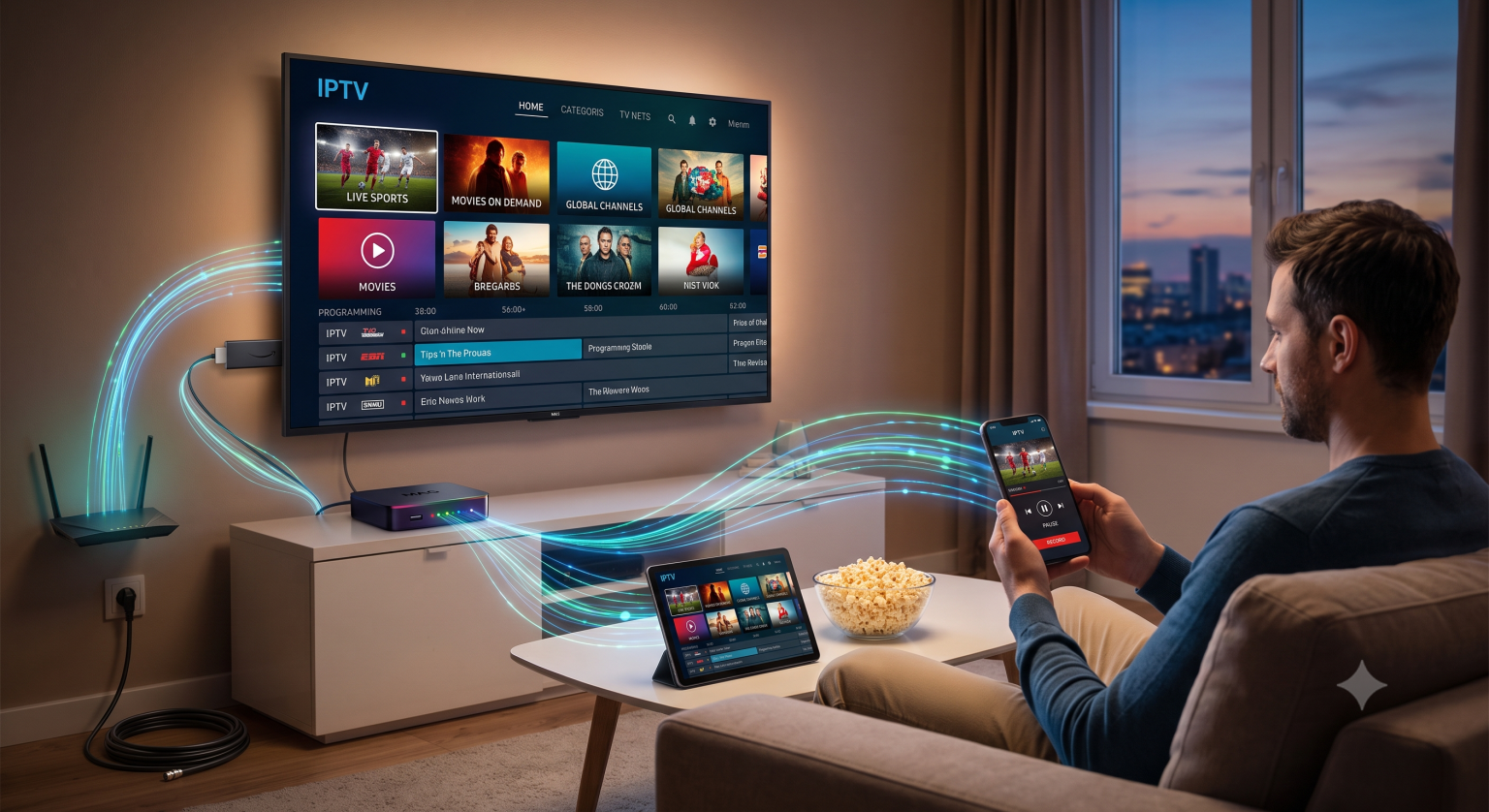
Que signifie « IPTV » ?
IPTV signifie Protocole Internet Télévision.
En termes simples, cela signifie diffuser du contenu télévisuel en utilisant la même infrastructure Internet que celle qui permet de charger les sites web et d'envoyer vos e-mails. Au lieu qu'un diffuseur envoie un signal vers une antenne géante ou un satellite, la vidéo est découpée en petits paquets de données numériques et transmise directement à votre adresse IP via votre connexion haut débit.
Comment fonctionne l'IPTV ?
La télévision traditionnelle est un moyen de communication à sens unique. Un câblo-opérateur diffuse simultanément des centaines de chaînes chez vous, que vous les regardiez ou non. C’est extrêmement inefficace et cela limite la quantité de contenu qu’il peut réellement proposer.
L'IPTV fonctionne selon un système de demande réciproque. Voici ce qui se passe en coulisses lorsque vous cliquez sur « Lecture » :
Vous faites une demande : Vous cliquez sur une chaîne ou un film à l'aide de votre télécommande.
Le serveur répond : Votre appareil communique avec le Fournisseur IPTV‘le serveur de….
Les données sont transmises en continu : Le serveur ne diffuse en temps réel que cette émission ou cette chaîne spécifique chez vous.
Votre appareil le décode : Votre téléviseur ou votre clé de streaming réassemble ces paquets de données entrants pour produire une vidéo et un son de haute qualité.
Comme le réseau n'est pas encombré par 500 chaînes que vous ne regardez pas, le fournisseur peut proposer un catalogue quasi infini de contenus à la demande.
Les trois principaux types d'IPTV
L'IPTV ne se résume pas à une seule chose. En réalité, cela englobe trois façons distinctes de regarder des vidéos :
IPTV en direct : C'est exactement ce que cela laisse entendre. Vous regardez en direct des retransmissions sportives, des journaux télévisés et des événements diffusés par les chaînes, le tout en temps réel, mais via Internet plutôt que par le câble traditionnel.
Vidéo à la demande (VOD): Imaginez cela comme une immense vidéothèque numérique. Vous choisissez un film ou une série télévisée dans un catalogue et vous la regardez exactement quand vous le souhaitez.
Télévision en différé (Rattrapage): Vous avez raté la diffusion en direct de votre émission préférée hier soir ? Les services de télévision en différé conservent les émissions récentes pendant quelques jours, ce qui vous permet de les revoir sans avoir besoin d'un magnétoscope numérique.
IPTV, télévision traditionnelle et OTT
Vous vous dites peut-être :, “ Attends, Netflix, c'est pas techniquement de l'IPTV ? ” Pas tout à fait. Bien qu'ils utilisent tous les deux Internet, il existe une différence technique dans la manière dont la vidéo est gérée et diffusée.
| Fonctionnalité | Télévision traditionnelle par câble/satellite | OTT (Over-the-Top) | Véritable IPTV |
| Exemples | Comcast, DirecTV | Netflix, Hulu, YouTube | Verizon Fios TV, opérateurs privés |
| Méthode de livraison | Ondes radio, câbles coaxiaux | L'Internet public | Un réseau privé géré |
| Contrôle qualité | Élevé (signal dédié) | Variable (en fonction du trafic sur le site) | Élevée (le fournisseur contrôle la bande passante) |
| Taille du contenu | Limité par la bande passante du câble | Vastes bibliothèques à la demande | Des catalogues très riches, en direct et à la demande |
Les services OTT s'appuient sur l'Internet ouvert. Si les habitants de votre quartier utilisent beaucoup Internet, la qualité de votre flux Netflix risque de baisser. La véritable IPTV fonctionne sur un réseau dédié et géré par un fournisseur, ce qui garantit qu’une quantité spécifique de bande passante est toujours réservée exclusivement à votre flux vidéo.
Pourquoi tout le monde se met-il à changer de système ?
L'abandon de la diffusion traditionnelle s'accélère pour plusieurs raisons très claires :
1. Une réduction considérable des coûts
Les offres de télévision par câble sont grevées de frais cachés de location de matériel et de suppléments facturés par les chaînes de télévision. Comme les fournisseurs d’IPTV n’ont pas à entretenir des milliers de miles de câbles en cuivre ni à lancer des satellites, leurs frais généraux sont bien moins élevés, et ces économies sont répercutées sur l’utilisateur.
2. Liberté d'utilisation sur plusieurs appareils
Le câble vous oblige à rester dans la pièce où se trouve le décodeur. Avec l'IPTV, votre abonnement est lié à votre identifiant de connexion. Vous pouvez suivre un match de foot en direct depuis votre salon Téléviseur connecté, mettez-le en pause, puis terminez de le regarder sur votre smartphone pendant que vous êtes dans le train.
3. Accès mondial aux chaînes
Un abonnement standard au câble donne accès à des chaînes locales et nationales. L'IPTV n'étant pas soumise à des restrictions géographiques, un seul abonnement vous permet d'accéder à la fois à des chaînes sportives britanniques, à des chaînes d'information latino-américaines et à des chaînes de divertissement japonaises, le tout en un seul endroit.
De quels appareils avez-vous besoin ?
L'un des principaux avantages de cette technologie est que vous disposez probablement déjà du matériel nécessaire pour l'utiliser. Vous n'avez pas besoin d'un technicien pour percer des trous dans vos murs. Il vous suffit d'une connexion Internet et de l'un des éléments suivants :
Téléviseurs connectés : La plupart des téléviseurs Samsung, LG et Android récents intègrent des applications conçues pour lire les listes de lecture IPTV.
Clés de streaming : Les Amazon Fire TV Stick, Roku et Apple TV sont des supports extrêmement populaires pour les applications IPTV telles que TiviMate ou IPTV Smarters.
Décodeurs dédiés : Des appareils tels que Boîtiers MAG sont spécialement conçues pour l'IPTV et offrent une expérience utilisateur qui reproduit parfaitement celle d'un guide des programmes du câble traditionnel.
Ordinateurs et téléphones : Des logiciels tels que VLC Media Player ou des applications iOS/Android spécialisées permettent de diffuser des flux en continu sans aucun problème.
La TVIP est-elle légale ?
C'est la question que l'on me pose le plus souvent, et la réponse nécessite quelques nuances.
La technologie en elle-même est conforme à la norme 100%. La télévision par protocole Internet n'est qu'un moyen de transmission de données. Les grands opérateurs de télécommunications, comme AT&T et Verizon, l'utilisent depuis des années pour diffuser leurs offres de télévision payante.
La légalité dépend entièrement de qui qui fournit le contenu et s’il a payé les droits de diffusion. Si un fournisseur propose 10 000 chaînes de cinéma premium et des événements sportifs à la carte pour quelques dollars par mois, il est probable qu’il ne dispose pas des licences nécessaires. Il existe toutefois de nombreux services IPTV légitimes et agréés qui fonctionnent en toute légalité.
En résumé
Nous assistons aux derniers jours du câble traditionnel. À mesure que les débits Internet augmentent partout dans le monde, la diffusion de vidéos via des paquets de données constitue tout simplement un moyen plus efficace, plus rapide et plus personnalisable de regarder la télévision. Que vous souhaitiez réduire considérablement vos factures mensuelles ou accéder à des contenus internationaux introuvables ailleurs, comprendre le fonctionnement de l’IPTV est la première étape pour vous constituer un système de divertissement plus performant.