
Choosing a new television for a room with large windows requires careful planning. Natural sunlight can make a dark television screen very difficult to watch. In 2026, the two best premium television technologies are RGB Mini LED and OLED. Both display technologies offer excellent picture quality. However, the two technologies handle room lighting very differently.
A bright living room needs a television that can overcome window glare. The television must also maintain color accuracy during the daytime. This article compares RGB Mini LED vs OLED to help you choose the correct television for a bright living room. We will examine brightness levels, reflection handling, and sports viewing performance.
Snabbsvar
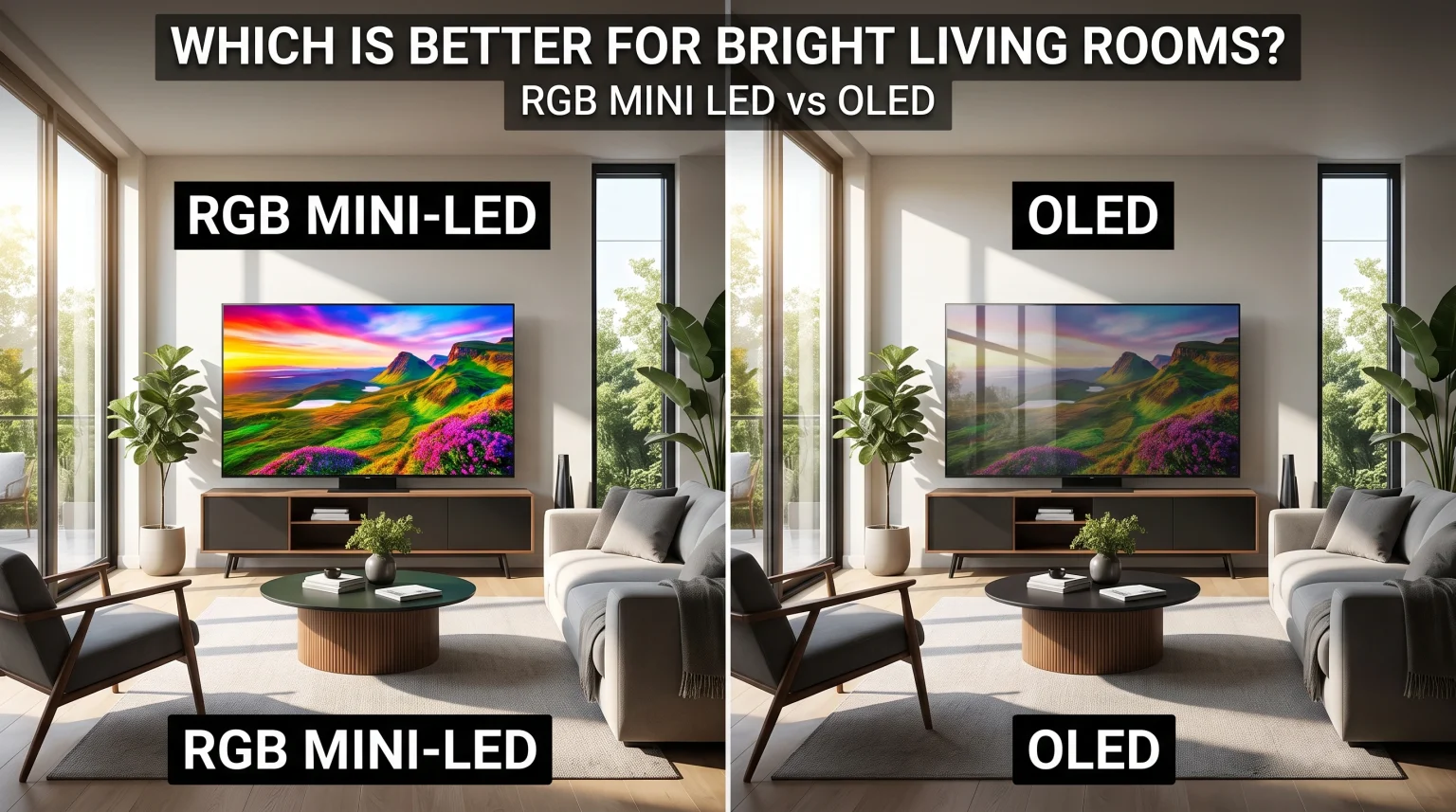
For a bright living room with direct sunlight, RGB Mini LED is the better choice. Mini LED televisions produce significantly higher maximum brightness levels. Mini LED screens easily overcome heavy glare from large windows.
OLED televisions are better for dark rooms or dimly lit spaces. OLED screens provide perfect black levels and infinite contrast. However, OLED screens cannot reach the same maximum brightness as Mini LED screens. Therefore, users with bright daytime viewing conditions should buy an RGB Mini LED television.
Understanding the Display Technologies in 2026
To understand the RGB Mini LED vs OLED comparison, you must understand how each technology creates light.
What Is RGB Mini LED?
An RGB Mini LED television uses an LCD (Liquid Crystal Display) panel. Behind the LCD panel, the television has thousands of microscopic light-emitting diodes (LEDs). These tiny LEDs create the backlight. The television groups these LEDs into hundreds or thousands of dimming zones. The television can turn these zones brighter or darker independently. This process is called local dimming. RGB Mini LED panels use red, green, and blue color filters to create a very wide color spectrum.
What Is OLED?
OLED stands for Organic Light-Emitting Diode. An OLED television does not have a backlight. Instead, every individual pixel creates its own light. The television can turn each pixel completely off. This creates perfect black colors. Modern OLED televisions in 2026 often use additional technologies like Micro Lens Array (MLA) or Quantum Dot (QD-OLED) layers. These additions help the OLED panel reach higher brightness levels than older OLED models.
Brightness and Reflection Handling
Brightness is the most important feature for a television in a bright living room. Television brightness is measured in a unit called “nits”.
RGB Mini LED televisions are extremely bright. In 2026, premium Mini LED televisions can easily produce 3,000 to 5,000 nits of peak brightness. This massive light output cuts through direct sunlight. You can watch dark television scenes clearly, even during the middle of the day.
OLED televisions are less bright. Even with modern MLA and QD-OLED improvements, high-end OLED televisions generally produce between 1,000 and 1,500 nits of peak brightness. OLED televisions also use an Automatic Brightness Limiter (ABL). The ABL automatically reduces the screen brightness when a bright image fills the entire screen. This protects the OLED panel from overheating.
Because of the ABL, a full-screen bright image on an OLED television will look much darker than the same image on a Mini LED television. Therefore, RGB Mini LED is vastly superior for heavily sunlit rooms.
Anti-Glare Coatings and Viewing Angles
Living rooms often have multiple seating positions. A good television must look clear from different angles.
OLED televisions have excellent viewing angles. The picture does not lose color or contrast when you sit on the side of the room. OLED screens also feature glossy anti-glare coatings. These coatings reduce the intensity of light reflections.
Mini LED televisions generally use VA (Vertical Alignment) or IPS (In-Plane Switching) panels. High-end Mini LED televisions include special optical layers to improve viewing angles. However, the viewing angles on a Mini LED television are slightly worse than an OLED television. Mini LED televisions also use advanced anti-glare coatings. Because the Mini LED backlight is so strong, reflections are rarely a problem for the viewer.
Kontrast och svärta
Contrast is the difference between the brightest white and the darkest black on the screen.
OLED televisions win the contrast category. Because OLED pixels turn off completely, the screen produces perfect zero-level black. Bright objects against a dark background look perfect. The television shows absolutely no light leakage around bright objects.
Mini LED televisions rely on local dimming zones. When a bright object appears on a dark background, the dimming zone behind the object must turn on. Sometimes, light leaks into the dark areas around the object. This light leakage is called “blooming” or “halo effect”. In 2026, advanced Mini LED televisions control blooming very well. However, Mini LED contrast still cannot match OLED contrast in a dark room.
In a bright living room, human eyes cannot see perfect zero-level black. The ambient room light hides the perfect contrast of the OLED screen. Therefore, the OLED contrast advantage disappears during daytime viewing.
Comparison Table: RGB Mini LED vs OLED
| Funktion | RGB Mini LED | OLED |
| Backlight technology | Thousands of microscopic LEDs | No backlight (self-illuminating pixels) |
| Peak brightness | Very high (3,000+ nits) | Moderate to high (1,000 – 1,500 nits) |
| Full-screen brightness | Utmärkt | Limited by Automatic Brightness Limiter |
| Black levels | Very deep, but minor blooming | Perfect, zero light leakage |
| Prestanda i ljust rum | Utmärkt | Genomsnitt |
| Dark room performance | Mycket bra | Utmärkt |
| Betraktningsvinklar | Good (varies by panel type) | Perfekt |
| Burn-in risk | Ingen risk | Very low risk |
Watching Live Football in Bright Rooms
Many people watch live football and other sports during the afternoon. Sports broadcasting requires specific television capabilities.
Football matches feature a bright green pitch that fills the entire screen. As mentioned earlier, OLED televisions use an Automatic Brightness Limiter (ABL). When a bright green football pitch fills an OLED screen, the ABL will lower the overall brightness. The match may look slightly dim during daytime viewing.
Mini LED televisions do not restrict full-screen brightness significantly. A football match on a Mini LED television will look vibrant and bright, even with sunlight shining into the room.
Both technologies offer excellent motion handling for fast sports. Premium models from brands like Samsung, Sony, and LG feature 120Hz refresh rates. A 120Hz refresh rate ensures the football moves smoothly across the screen without blurring. If you want to understand more about motion processing, read our guide on TV med 60 Hz jämfört med 120 Hz för direktsänd fotboll.
Additionally, you can read our specific comparison regarding OLED kontra Mini-LED för direktsänd fotboll to learn more about motion clarity.
IPTV Compatibility and Picture Quality
Many users want to watch streaming television using IPTV applications. Your choice between RGB Mini LED vs OLED does not affect IPTV application compatibility.
IPTV compatibility depends entirely on the Smart TV operating system. You must check if the television uses Google TV, Samsung Tizen, or LG webOS. These operating systems determine which IPTV players you can install. If you need help choosing an operating system, read our guide on De bästa smart-tv-apparaterna för IPTV år 2026: Jämförelse mellan Samsung, Sony, LG och TCL.
However, the screen technology does affect how your IPTV streams look. Many live television channels broadcast in 1080p or 720p resolution. The television must upscale this lower-resolution video to 4K. Both premium Mini LED and premium OLED televisions feature excellent internal processors for upscaling.
För TV Shadow IPTV users, a stable internet connection is essential. Connect your television directly to your internet router using an Ethernet cable. This direct connection provides better streaming stability for live television than a Wi-Fi connection.
Screen Burn-In and Longevity
Screen burn-in happens when a static image stays on the screen for many hours. The static image permanently damages the pixels. A faint ghost of the image remains visible forever.
OLED televisions carry a small risk of permanent screen burn-in. News channel logos, sports scoreboards, and video game interfaces are static images. Modern OLED televisions in 2026 use advanced software to prevent burn-in. The television will automatically shift pixels and dim static logos. Under normal viewing conditions, modern OLED burn-in is very rare.
Mini LED televisions use LCD panels. LCD panels are completely immune to permanent screen burn-in. You can leave a news channel or a sports scoreboard on a Mini LED television all day without any risk. This makes Mini LED a safer choice for background television viewing.
Slutsats
The debate between RGB Mini LED vs OLED in 2026 depends entirely on your room environment.
If you have a bright living room with large windows, RGB Mini LED is the superior choice. Mini LED televisions offer massive peak brightness and full-screen brightness. The Mini LED screen will cut through heavy daylight and window glare. Furthermore, Mini LED televisions carry zero risk of permanent screen burn-in.
If you have a dark room or a dedicated home cinema, OLED remains the ultimate picture technology. OLED provides perfect black levels and infinite contrast. However, the lower maximum brightness and the Automatic Brightness Limiter make OLED less suitable for sunny living rooms and daytime sports viewing. Evaluate your room lighting carefully before purchasing your new television.
Vanliga frågor (FAQ)
Does sunlight damage an OLED television screen?
Yes, direct ultraviolet (UV) sunlight can damage an OLED panel. You should never place an OLED television where direct, strong sunlight hits the screen physically. The sunlight can degrade the organic materials inside the pixels. Mini LED televisions are much more resistant to direct sunlight.
Which television technology lasts longer?
Mini LED televisions generally have a longer lifespan. The LED backlight degrades very slowly over many years. OLED panels use organic compounds that degrade faster over time, especially if the television runs at maximum brightness constantly.
Is OLED bad for bright rooms?
OLED is not bad, but OLED is not optimal for very bright rooms. An OLED television will look beautiful in a bright room during dark scenes. However, during bright scenes, the screen may look dim compared to a Mini LED television. Reflections may also distract the viewer.
Do I need a 4K television for IPTV?
Yes, you should buy a 4K television. In 2026, almost all premium Mini LED and OLED televisions have a 4K resolution. Even if your IPTV service provides 1080p channels, the television processor will upscale the image to fit the 4K screen.
Does TV Shadow IPTV work on both Mini LED and OLED TVs?
Yes. TV Shadow IPTV compatibility depends on the television’s operating system, not the screen hardware. As long as your television allows you to install a compatible IPTV player application from its official app store, the service will function correctly.