
We’ve all been there. You’ve got the snacks ready, you sit down to watch a massive live sports event or the finale of your favorite show, and right at the most crucial moment the screen freezes. The dreaded buffering wheel of death appears.
If you are paying for an IPTV service, you expect it to work. But when Netflix streams perfectly and your IPTV struggles to load a single frame, it’s easy to blame the provider.
Surprisingly, the issue usually isn’t the IPTV service itself. More often than not, your internet service provider (ISP) is actively slowing down your stream. If you are looking for a reliable way to stop IPTV buffering, VPN solutions are generally the most effective fix.
Let’s break down exactly why your streams are stuttering and how you can tweak your network and VPN settings to kill the lag for good.
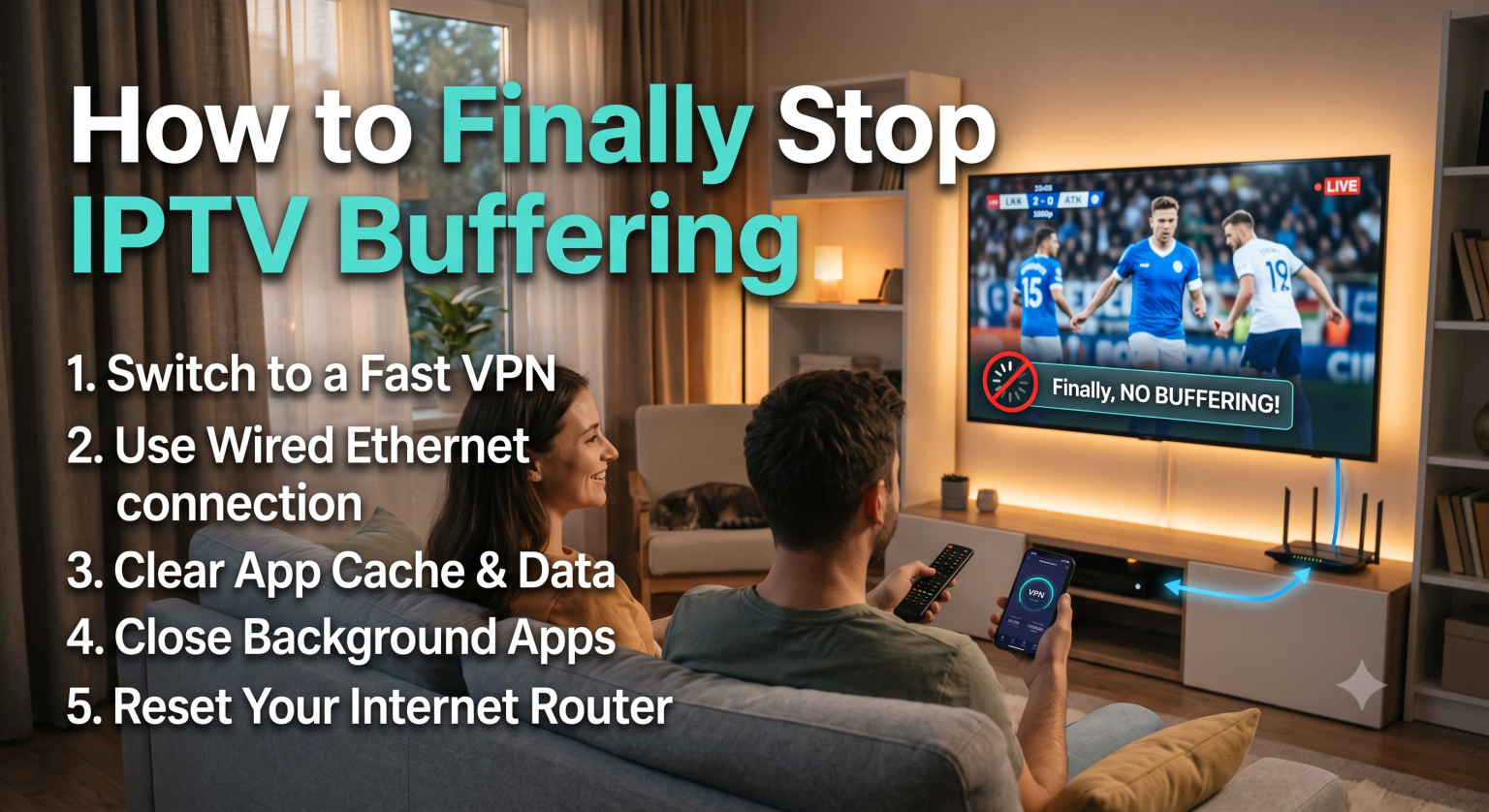
Why Does IPTV Buffer in the First Place?
Before fixing the problem, you have to know what’s causing it. IPTV buffering usually boils down to three main culprits:
Begrænsning af internetudbyderens båndbredde: This is the big one. Many internet providers actively monitor your web traffic. When they detect heavy video streaming especially from unrecognized IPTV servers they intentionally throttle (slow down) your bandwidth to save data on their network.
Overbelastning af netværket: If you are trying to watch TV at 8 PM on a Sunday, you are fighting for bandwidth with everyone else in your neighborhood.
Hardware Limits: Cheap streaming sticks can overheat, run out of memory, or struggle with weak Wi-Fi signals.
The Ultimate Fix to Stop IPTV Buffering: VPN Connections
If your internet speed tests show blazing-fast numbers but your IPTV still lags, you are almost certainly a victim of ISP throttling.
This is where a Virtual Private Network steps in. A VPN encrypts your internet traffic, scrambling the data so your ISP has absolutely no idea what you are doing. Because they can’t see that you are pulling massive amounts of video data from an IPTV server, they can’t trigger their automated speed throttles.
They just see a secure stream of unreadable data. Your speed stays maxed out, and the buffering stops.
The Best VPN Settings for Smooth Streaming
Just turning on a VPN isn’t always enough. If it’s configured incorrectly, a VPN can actually slow you down. To guarantee a flawless stream, dive into your VPN app settings and make these quick adjustments:
1. Switch to a Fast Protocol (WireGuard or UDP)
Not all VPN protocols are built the same. If your VPN is set to a heavy encryption protocol like TCP, it prioritizes absolute data accuracy over speed which causes lag.
Dig into your settings and switch your protocol to WireGuard (the current gold standard for speed) or OpenVPN (UDP). UDP doesn’t wait around to double-check every packet of data, making it vastly superior for live video.
2. Connect to the Closest Possible Server
Don’t just hit the “auto-connect” button. Distance equals latency. If you live in London, connecting to a VPN server in Tokyo to watch TV is going to cause massive delays. Manually select a VPN server that is physically close to your actual location, ideally one with a low user load.
3. Enable Split Tunneling
Processing encrypted data takes a toll on your streaming device’s CPU. If your VPN app offers “Split Tunneling,” turn it on. This feature allows you to route kun your IPTV-app through the secure VPN tunnel, while leaving your weather apps, background updates, and regular web browsers on your standard network. Taking the unnecessary load off the VPN dramatically improves streaming performance.
Beyond the VPN: Quick Hardware Fixes
If you’ve optimized your VPN and you still get the occasional stutter, your home network might need a tune-up.
Glem alt om Wi-Fi: Wi-Fi is incredibly vulnerable to interference from walls, microwaves, and even your neighbors’ routers. Hardwire your streaming device directly to your router using an Ethernet cable. If you use a Firestick, pick up a cheap USB Ethernet adapter. This one change fixes 90% of home network issues.
Clear Your App Cache: Streaming apps build up massive amounts of temporary data. When a device’s storage gets full, the processor bogs down. Go into your device settings, find your IPTV app, and hit “Clear Cache” at least once a month.
Change Your DNS: Sometimes your ISP’s default routing is just terrible. Try changing the DNS settings on your router or streaming device to Cloudflare (1.1.1.1) or Google (8.8.8.8) for faster response times.
Afsluttende tanker
You don’t have to put up with a stuttering screen. By recognizing that your ISP is likely the one hitting the brakes on your bandwidth, you can take back control of your network.
To definitively stop IPTV buffering, VPN encryption combined with a hardwired Ethernet connection will give you the flawless, premium viewing experience you paid for.