
Are you tired of your phone buzzing with a goal notification before the striker even shoots on your screen? You are definitely not alone. Experiencing a Champions League stream delay is one of the most frustrating realities for soccer fans watching in the US today. Let’s break down exactly why your video feed lags behind real-time alerts and how you can minimize the gap.
The Science Behind a Champions League Stream Delay in the US
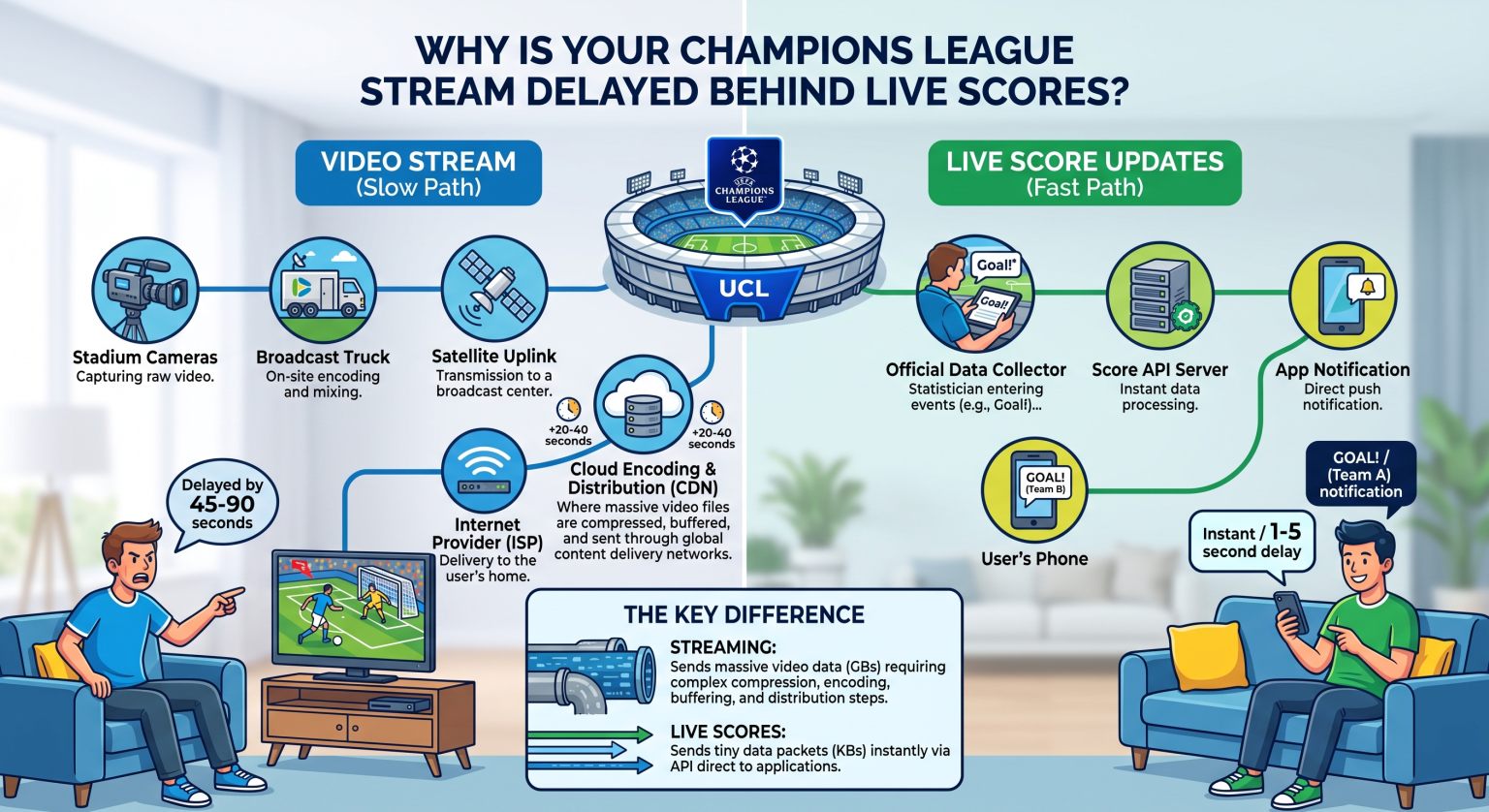
When you tune into a UEFA match from the US, the video signal takes a complex, transatlantic journey. The high-definition footage travels from European stadiums to production trucks, up to satellites, and then into regional broadcasting centers.
From there, platforms like Paramount+ must encode the massive video files for digital distribution. This extensive real-time sports broadcasting infrastructure creates a noticeable bottleneck. Because the video has to pass through Content Delivery Networks (CDNs) and buffer on your smart TV, a Champions League stream delay is practically inevitable.
Why Do Live Score Apps Update Instantly?
The discrepancy ultimately comes down to a race between massive video streams and microscopic data packets. Major sports data companies employ on-site “data scouts” in the stands who log every pass and goal the exact second it happens.
When the ball crosses the line, a tiny text packet is sent over cellular networks directly to app servers. Because this requires zero video processing, live score app speed will always outpace a 4K video feed.
Comparing Soccer Broadcast Latency
To understand why your Champions League stream delay feels so severe, it helps to compare the different ways we consume match data. Here is how the various mediums stack up:
| Broadcast Method | Average Latency | Primary Reason for Lag |
| Live Score Apps | 1 – 3 seconds | Minimal data processing; direct from on-site scouts. |
| Cable / Satellite TV | 10 – 30 seconds | Satellite transmission and broadcast editing buffers. |
| Digital Streaming | 45 – 90+ seconds | CDN distribution, video encoding, and device buffering. |
How to Minimize Your Champions League Stream Delay
While you cannot eliminate football streaming lag entirely, you can optimize your home network to close the gap. First, always hardwire your streaming device directly to your router using an Ethernet cable. A wired connection is far more stable than Wi-Fi, preventing unnecessary stream buffering issues.
Additionally, check if your streaming platform offers a “Low Latency” or “Live Sync” mode in the settings. Lowering the video quality slightly (e.g., from 4K to 1080p) can also drastically improve your live stream latency by reducing the amount of data your TV needs to process.
Conclusion: Reclaim Your Matchdays in the US
Dealing with a Champions League stream delay can take the magic out of those crucial knockout stages. By understanding the technological hurdles of transatlantic broadcasting and optimizing your local US network setup, you can keep the spoilers at bay.
Ready to upgrade your ultimate sports viewing setup? Sign up for our premium newsletter today to get exclusive networking guides, streaming platform reviews, and weekly tech tips delivered straight to your inbox!
People Also Ask (PAA)
How long is a typical live sports streaming delay?
Most digital streaming platforms experience a delay ranging from 45 seconds to over a minute compared to actual real-time events. This is due to the heavy data processing and buffering required to deliver high-quality video over the internet.
Why is cable TV faster than streaming?
Cable and satellite TV utilize direct transmission infrastructures that bypass the complex internet encoding and CDN distribution required for web-based streams. As a result, cable usually only lags 10 to 30 seconds behind real-time.
Can I completely fix a UEFA match delay?
You cannot completely eliminate broadcast latency due to the physical distance and processing required. However, using an Ethernet cable and lowering your stream’s resolution can significantly reduce the gap.