
The UEFA Champions League has undergone its most significant transformation in decades. If you are preparing for the 2026/27 season, understanding the new structure is essential for following your favorite club’s European journey. The traditional four-team group stage is completely gone, replaced by a massive single league table that changes how teams qualify for the knockout rounds.
Whether you are a long-time football fan or new to the competition, having the Champions League league phase explained clearly will help you track the stakes of every matchday.
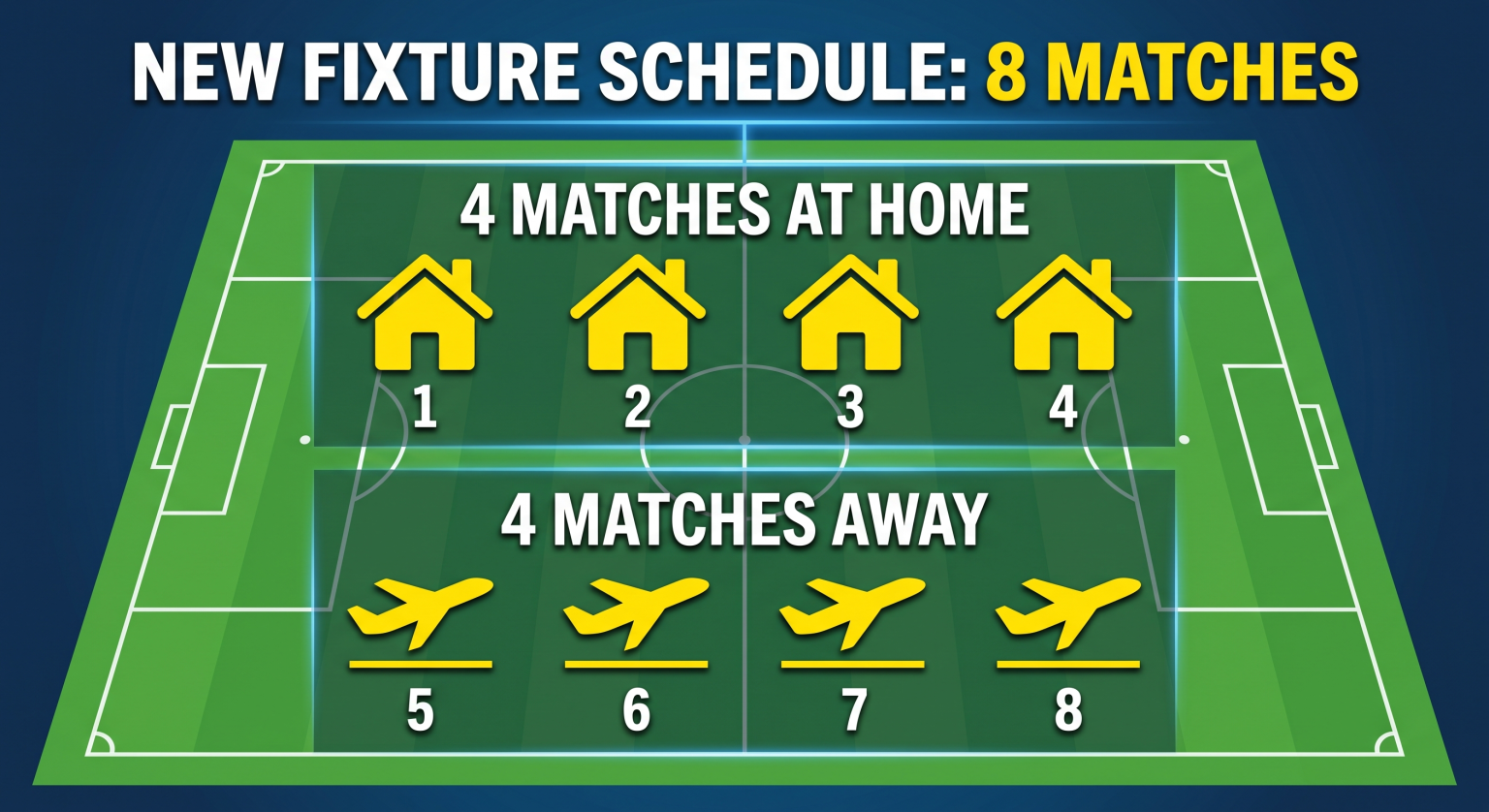
What is the Champions League league phase? The Champions League league phase is a single-table competition featuring 36 clubs, replacing the old group stage format. Every team plays eight matches against eight different opponents (four at home, four away). The top eight teams in the table advance directly to the Round of 16. Teams finishing from 9th to 24th enter a two-legged playoff to secure their knockout spot, while teams finishing 25th to 36th are eliminated from all European competition.
How the 36-Team League Phase Works
The 2026/27 Champions League season continues the expanded format introduced recently by UEFA. Instead of being drawn into small groups of four, all 36 participating clubs compete in one unified league table.
The Eight-Match Schedule
Under the old system, teams played three opponents twice (home and away). In the new league phase, each team plays eight matches against eight different opponents.
To determine these fixtures, teams are divided into four seeding pots based on their UEFA club coefficients. Every club is drawn to play two teams from each of the four pots. For each pot, they play one match at home and one match away. This ensures a balanced schedule, meaning top-seeded clubs will face other top-seeded clubs early in the tournament.
If you want to understand exactly how these pots are decided before the season begins, you can read our previous article on how the Champions League draw works.
Points and Standings
The points system remains the same as in any domestic league:
Win: 3 points
Draw: 1 point
Loss: 0 points
All points are tallied on the single 36-team table. Because teams do not play the same opponents, the standings can change dramatically with every goal scored across Europe.
How Do Teams Qualify for the Knockout Rounds?
With 36 teams in a single table, the race to qualify for the next stage is highly competitive. Every position in the table matters. Here is how the final standings determine a club’s fate:
1st to 8th Place: Direct Qualification
The top eight teams at the end of the eight matchdays are rewarded with a direct bye to the Round of 16. Furthermore, these eight teams are seeded in the knockout draw, meaning they will have the advantage of playing the second leg of their Round of 16 tie at home.
9th to 24th Place: The Playoff Round
Clubs that finish between 9th and 24th place must compete in a two-legged knockout playoff round.
Teams ranked 9th to 16th are seeded and will play the second leg at home.
Teams ranked 17th to 24th are unseeded.
The winners of these playoff ties advance to the Round of 16 to face the top eight teams. For a complete look at what happens after this stage, read our next article covering the Champions League knockout stages.
25th to 36th Place: Complete Elimination
Unlike previous years, there is no safety net for underperforming teams. Clubs that finish in 25th place or lower are eliminated entirely from European competition. They do not drop down to the UEFA Europa League.
Tiebreakers: What Happens When Teams Tie on Points?
Because 36 teams are competing in a single table over only eight matches, it is statistically guaranteed that multiple clubs will finish with the exact same number of points.
UEFA uses a strict set of tiebreaker rules to separate teams. If two or more teams are level on points, the following criteria are applied in order:
Goal difference in the league phase.
Goals scored in the league phase.
Away goals scored in the league phase.
Wins in the league phase.
Away wins in the league phase.
Higher number of points obtained collectively by league phase opponents.
Superior collective goal difference of league phase opponents.
Higher number of goals scored collectively by league phase opponents.
Lower disciplinary points total (red cards and yellow cards).
UEFA club coefficient.
The introduction of opponent-based tiebreakers (criteria 6, 7, and 8) means that the strength of a team’s schedule can ultimately decide their final ranking if all direct statistics are identical.
Why Did UEFA Change the Format?
The transition to the single league phase was designed to solve several issues with the old group stage format:
More High-Profile Matches: Because teams play opponents from Pot 1 immediately, fans get to see heavyweights like Real Madrid, Manchester City, and Bayern Munich face each other much earlier in the season.
Fewer Dead Matches: In the old format, big clubs often qualified after four games, making their final two matches meaningless. In a single 36-team table, goal difference and final placement (to secure a top-eight spot or a seeded playoff spot) matter until the final minute of Matchday 8.
Variety of Opponents: Playing eight different teams instead of three provides a wider variety of tactical matchups.
For a broader overview of the tournament, you can always visit our main Champions League hub.
Troubleshooting Your Viewing Experience
When Matchday 8 arrives in late January, all 18 matches are played simultaneously. This is one of the most demanding broadcasting nights in sports. If you are streaming the matches using TV Shadow IPTV, follow these basic troubleshooting steps to ensure a stable connection:
Check Your Internet Speed: Live sports require a steady connection. We recommend a minimum of 25 Mbps for standard HD and 50 Mbps for 4K streaming.
Use a Wired Connection: If your device is buffering, switch from Wi-Fi to a direct Ethernet cable connection.
Restart Your Router and Device: Clear your hardware’s cache by unplugging your streaming device and router for 60 seconds before kickoff.
Legal Broadcasting Rights: Always ensure you are accessing content legally. TV Shadow IPTV provides the software and platform, but you must subscribe to the official licensed sports broadcasters in your specific country to watch UEFA Champions League matches.
Conclusion
The 36-team single league table has completely modernized European football. Having the Champions League league phase explained allows you to appreciate the tactical depth, the importance of goal difference, and the intense pressure teams face to finish in the top eight. With every club fighting for their position until the final whistle of Matchday 8, the road to the final is more exciting than ever.
Ensure your internet connection is optimized, verify your local official broadcaster, and enjoy the biggest club competition in the world.
Frequently Asked Questions (FAQ)
How many matches does each team play in the league phase?
Every team plays a total of eight matches in the league phase. They play four matches at home and four matches away, against eight different opponents.
Do teams play the same opponent twice in the league phase?
No. Unlike the old format where teams played home and away against the same club, teams now play eight completely different clubs.
What happens if a team finishes 25th in the league phase?
Any team finishing from 25th to 36th place is immediately eliminated from the Champions League. They do not drop into the Europa League.
How does the Champions League playoff round work?
Teams finishing between 9th and 24th place face off in a two-legged playoff. The clubs ranked 9th to 16th play against the clubs ranked 17th to 24th, with the higher-ranked teams getting home advantage in the second leg.
When does the league phase end?
The league phase runs from September through January. The final matchday (Matchday 8) takes place at the end of January, with all matches kicking off simultaneously.