
Choosing a new television for IPTV streaming requires an understanding of modern screen technology. Television manufacturers use different methods to display light and color on the screen. Today, OLED, QLED, and Mini-LED represent the most popular display technologies.
Each technology handles picture brightness, dark colors, and moving objects differently. These technical differences directly affect how your IPTV streams look in your living room. OLED provides perfect black colors because each pixel produces its own light. QLED uses a standard LED backlight with a special color layer to create bright images. Mini-LED improves upon QLED by using thousands of smaller lights for better picture control.
The right television choice depends on your room lighting, your budget, and the type of content you watch through TV Shadow IPTV.
Quick Answer
OLED provides the best picture quality for dark rooms because OLED pixels can turn off completely to create perfect black colors. QLED is the most affordable option, offering bright colors that work well in rooms with natural sunlight. Mini-LED delivers a balance of both technologies. A Mini-LED television provides very high brightness and excellent contrast control.
Choose OLED for watching cinematic movies in dark environments. Choose QLED for budget-friendly everyday television viewing. Choose Mini-LED if you watch live sports in a bright room and want premium picture quality without the risk of screen burn-in.
Understanding TV Screen Technologies
To choose the best television for IPTV, you must understand how these three screen types operate.
What is OLED?
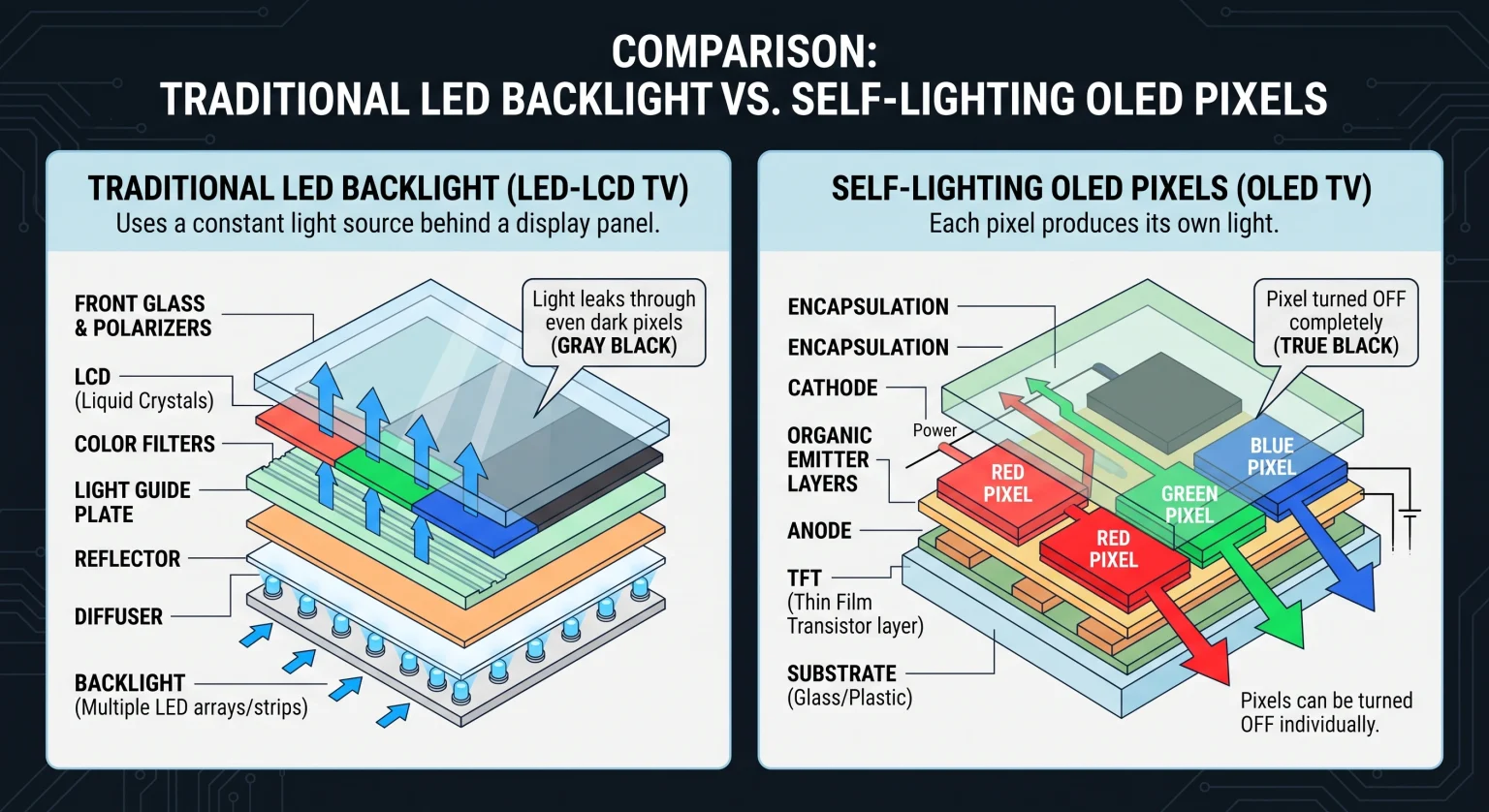
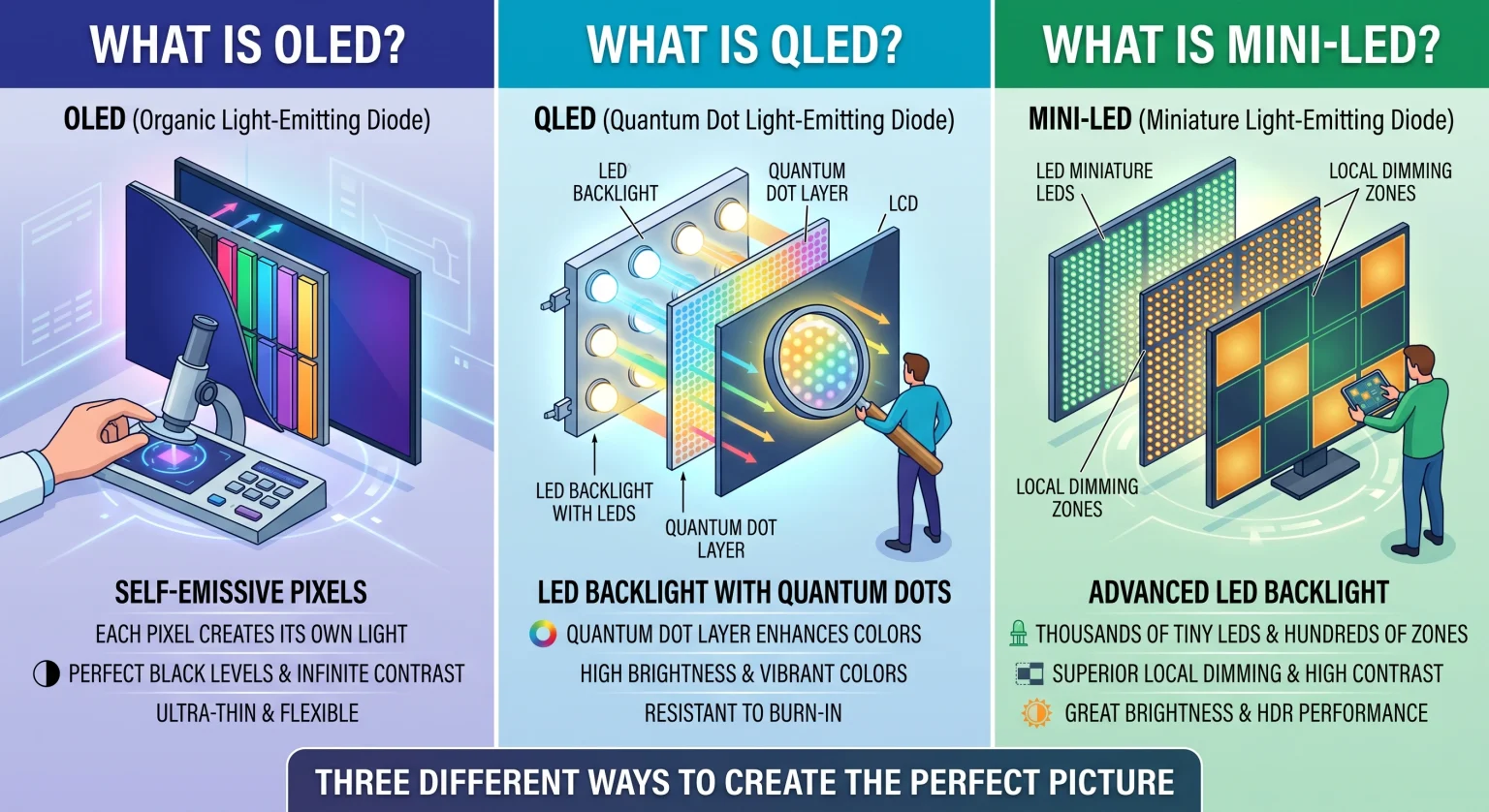
OLED stands for Organic Light-Emitting Diode. An OLED television does not use a traditional backlight behind the screen. Instead, every individual pixel creates its own light and its own color.
Because each pixel operates independently, an OLED television can turn individual pixels off completely. When a pixel turns off, it creates a perfect black color. This ability creates an infinite contrast ratio. An infinite contrast ratio means the difference between the brightest white and the darkest black is extremely high.
OLED screens have excellent viewing angles. If you sit on the side of the room, the picture colors do not fade. OLED televisions also have very fast pixel response times. A fast response time reduces blur during fast-moving scenes. However, OLED televisions are usually less bright than QLED or Mini-LED televisions.
What is QLED?
QLED stands for Quantum Dot Light-Emitting Diode. A QLED television is an LCD television that uses a traditional LED backlight. Manufacturers add a layer of microscopic quantum dots between the backlight and the screen.
When the LED backlight shines through the quantum dot layer, the quantum dots produce vibrant and accurate colors. QLED televisions can become very bright. This high brightness makes QLED televisions excellent for rooms with large windows and bright sunlight.
QLED televisions are usually cheaper to manufacture than OLED televisions. However, because QLED televisions use a backlight, they cannot create perfect black colors. Sometimes, light leaks into the dark areas of the screen. This light leak creates a gray effect during dark movie scenes.
What is Mini-LED?
Mini-LED is an advanced version of QLED technology. A Mini-LED television still uses an LCD screen and a quantum dot color layer. The main difference is the backlight.
Instead of using a small number of large LED lights, a Mini-LED television uses thousands of microscopic LED lights. Manufacturers divide these tiny lights into hundreds or thousands of “local dimming zones”. The television software controls these zones independently.
If a scene requires dark colors on one side of the screen and bright light on the other side, the television turns off the dimming zones in the dark area. This system gives Mini-LED televisions high brightness and very strong contrast. Mini-LED contrast is almost as good as OLED contrast.
OLED vs QLED vs Mini-LED Comparison
| Feature | OLED | QLED | Mini-LED |
| Backlight type | No backlight (self-lit pixels) | Large LED backlight | Thousands of tiny LEDs |
| Black levels | Perfect black | Average black | Very good black |
| Maximum brightness | Average brightness | High brightness | Very high brightness |
| Viewing angle | Excellent | Average | Good |
| Room environment | Best for dark rooms | Good for bright rooms | Excellent for bright rooms |
| Price category | High price | Low to medium price | Medium to high price |
Which Screen is Best for Live Football and Sports?
Watching live football through an IPTV service requires a television that handles motion well. When the camera moves quickly across a football pitch, the television must update the image rapidly to prevent motion blur.
OLED televisions are excellent for live sports because they have nearly instant pixel response times. The pixels change color immediately, which keeps the football and the players sharp during fast camera movements.
However, many people watch live football on Saturday or Sunday afternoons. During the daytime, sunlight enters the living room. OLED televisions can struggle to overcome bright sunlight.
For daytime sports viewing, Mini-LED is often the best choice. Mini-LED televisions produce extreme brightness that easily fights glare from windows. They also handle motion very well. When you evaluate televisions for sports, you should also consider the refresh rate. We explain this hardware feature in our guide to choosing a 60Hz vs 120Hz TV for Live Football]. A 120Hz television provides smoother motion for sports broadcasts.
Does Screen Technology Affect IPTV Applications?
The screen technology (OLED, QLED, or Mini-LED) only controls the physical picture quality. The screen technology does not control which IPTV applications you can install.
Application compatibility depends entirely on the Smart TV operating system. For example, Samsung uses the Tizen operating system for its OLED, QLED, and Mini-LED televisions. LG uses the webOS operating system across all its screen types. Sony uses Google TV across its OLED and Mini-LED models.
Before you purchase a television for TV Shadow IPTV, you must check the operating system. If you want a wide selection of IPTV player applications, Google TV offers the largest app store. To learn more about software differences, read our comparison of Best Smart TV OS for IPTV in 2026].
You can enjoy TV Shadow IPTV on OLED, QLED, and Mini-LED screens. Just ensure the television uses an operating system that supports your preferred IPTV player.
Understanding Resolution and Upscaling
Most modern OLED, QLED, and Mini-LED televisions have a 4K resolution. A 4K television contains over eight million pixels. However, many live television channels broadcast in Standard Definition (SD), High Definition (HD), or Full HD (1080p).
When you watch a 1080p IPTV stream on a 4K television, the television must use software to stretch the image to fill the screen. This process is called upscaling.
A premium OLED or Mini-LED television usually contains an advanced picture processor. This computer chip cleans the image, removes digital noise, and improves the clarity of lower-resolution IPTV streams. A cheap QLED television might have a weak processor, which can make HD streams look slightly blurry. If you want to understand this process deeply, read our article explaining What Is TV Upscaling and Does It Help IPTV?.
The Risk of Screen Burn-In
When comparing these technologies, buyers often ask about screen burn-in. Screen burn-in happens when a static image stays on the screen for many hours. The image leaves a permanent faint shadow on the display.
OLED televisions have a small risk of screen burn-in. This risk exists because the organic materials in the pixels can degrade unevenly. If you watch the same news channel for eight hours every day, the channel logo could eventually burn into the screen. Similarly, a static sports scoreboard could cause issues after thousands of hours.
However, modern OLED televisions use automatic pixel-shifting and screen-refreshing software to prevent burn-in. For most normal viewing habits, burn-in is very rare.
QLED and Mini-LED televisions do not use organic materials. Therefore, QLED and Mini-LED televisions have zero risk of permanent screen burn-in. If you often leave your television on a news channel with a static banner all day, a Mini-LED or QLED television is a safer long-term choice.
Color Performance and HDR
High Dynamic Range (HDR) technology improves video by making bright areas brighter and dark areas darker while showing more colors. The most common HDR formats are HDR10, HDR10+, and Dolby Vision.
OLED televisions perform beautifully with HDR content because their perfect black levels make the bright colors stand out strongly.
Mini-LED televisions perform exceptionally well with HDR content because their high peak brightness makes explosions, sunlight, and bright skies look realistic.
QLED televisions support HDR, but cheaper QLED models may lack the local dimming zones needed to display HDR content correctly.
When you use an IPTV service, most standard television channels do not use HDR. Standard live television uses Standard Dynamic Range (SDR). However, if you watch modern movies through on-demand streaming, a Mini-LED or OLED television will provide the best HDR experience.
Internet Connectivity for IPTV
The picture technology does not affect your internet connection. OLED, QLED, and Mini-LED televisions all include Wi-Fi antennas and Ethernet ports.
For the most stable IPTV experience, we recommend connecting your television directly to your internet router using an Ethernet cable. A wired Ethernet connection stops video buffering and maintains high picture quality, regardless of whether you own an OLED or QLED screen.
Conclusion
Choosing between OLED, QLED, and Mini-LED depends on how and where you watch TV Shadow IPTV.
If you want the ultimate picture quality for evening movies and you have a dark room, an OLED television is the best choice. OLED offers perfect blacks and excellent viewing angles.
If you want a large television on a strict budget, a standard QLED television provides vibrant colors and good brightness for a reasonable price.
If you watch a lot of live football during the daytime or you have a very bright living room, a Mini-LED television is an excellent investment. Mini-LED combines extreme brightness with high contrast, and it has absolutely no risk of screen burn-in.
Regardless of the screen technology you choose, ensure the television has an operating system that supports your favorite IPTV applications.
FAQ
Does the screen type affect IPTV buffering?
No. Buffering happens when your internet connection is slow or unstable. The television screen technology (OLED, QLED, or Mini-LED) does not control your internet speed.
Is OLED better than Mini-LED?
OLED is better for dark rooms because it provides perfect black colors. Mini-LED is better for bright rooms because it produces brighter images and fights window reflections easily.
Can I install IPTV apps on OLED televisions?
Yes, but the installation depends on the television’s operating system, not the screen type. An LG OLED television uses webOS, and a Sony OLED television uses Google TV. Both systems have available IPTV applications.
Does QLED support 4K resolution?
Yes. Almost all modern QLED televisions display a 4K resolution. The term QLED refers to the colors and backlight, not the resolution.
Which TV technology lasts the longest?
LED-based televisions (QLED and Mini-LED) generally have a longer lifespan without picture degradation. OLED televisions can slowly lose brightness over many years of heavy use.
Do I need a 120Hz television for IPTV?
You do not strictly need a 120Hz television to watch IPTV. Regular television shows and movies broadcast at lower frame rates. However, a 120Hz screen is very helpful for watching fast-moving live football.
Are Mini-LED televisions heavy?
Mini-LED televisions are generally thicker and slightly heavier than OLED televisions. OLED televisions are often incredibly thin because they do not require a backlight unit.