
Are you wondering why Vega OS streaming apps are suddenly dominating tech news? Amazon has officially replaced its Android-based Fire OS with a completely new, Linux-based platform [2]. For media brands and developers targeting the United States, this means existing Android APKs will no longer work and must be completely rebuilt.
This transition is arguably the biggest shakeup in the smart TV ecosystem in a decade. If you want to maintain your streaming audience on Amazon devices, understanding this migration is critical.
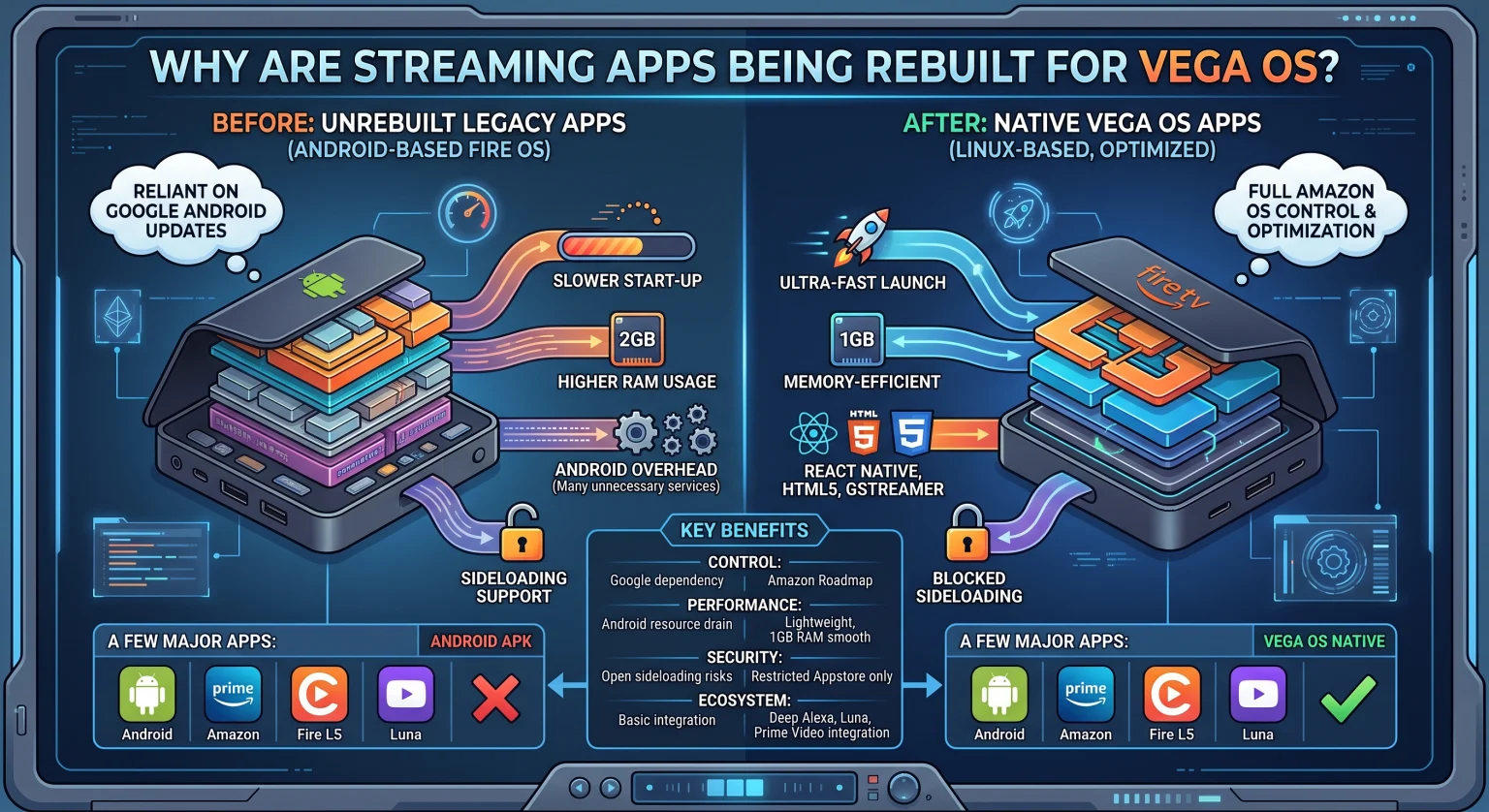
The Core Reason Behind Vega OS Streaming Apps in the US
Amazon’s move away from the Android Open Source Project (AOSP) is all about ecosystem control and performance optimization. By creating a custom Linux-based OS, Amazon breaks free from Google’s update cycles. This bold shift allows them to optimize TV interfaces and features specifically for their hardware.
However, this means that legacy apps have zero compatibility with the new system. Sideloading is no longer officially supported, which tightly secures the Appstore environment. As a result, OTT app development teams across the US are rushing to create native Vega OS streaming apps before the transition window closes
Technical Advantages of React Native for Vega
To streamline development, Amazon chose React Native as the core framework for its new interface. Instead of bundling the framework into every individual app, Amazon dynamically links the React Native runtime directly into the OS itself.
Faster Cold Starts: Pre-warmed processes reduce app launch times significantly.
Smaller App Sizes: Removing the React Native runtime cuts app bundle sizes by over 10MB.
Cross-Platform Reusability: Developers can share up to 90% of their business logic across other target platforms.
Leveraging W3C Media APIs for Playback
Instead of using the old Android media stack, the new ecosystem relies heavily on W3C Media APIs. This shift allows developers to utilize standard web technologies like MSE and EME for seamless video playback. Ultimately, this creates smoother, more reliable Vega OS streaming apps for viewers.
Comparing Smart TV Ecosystems
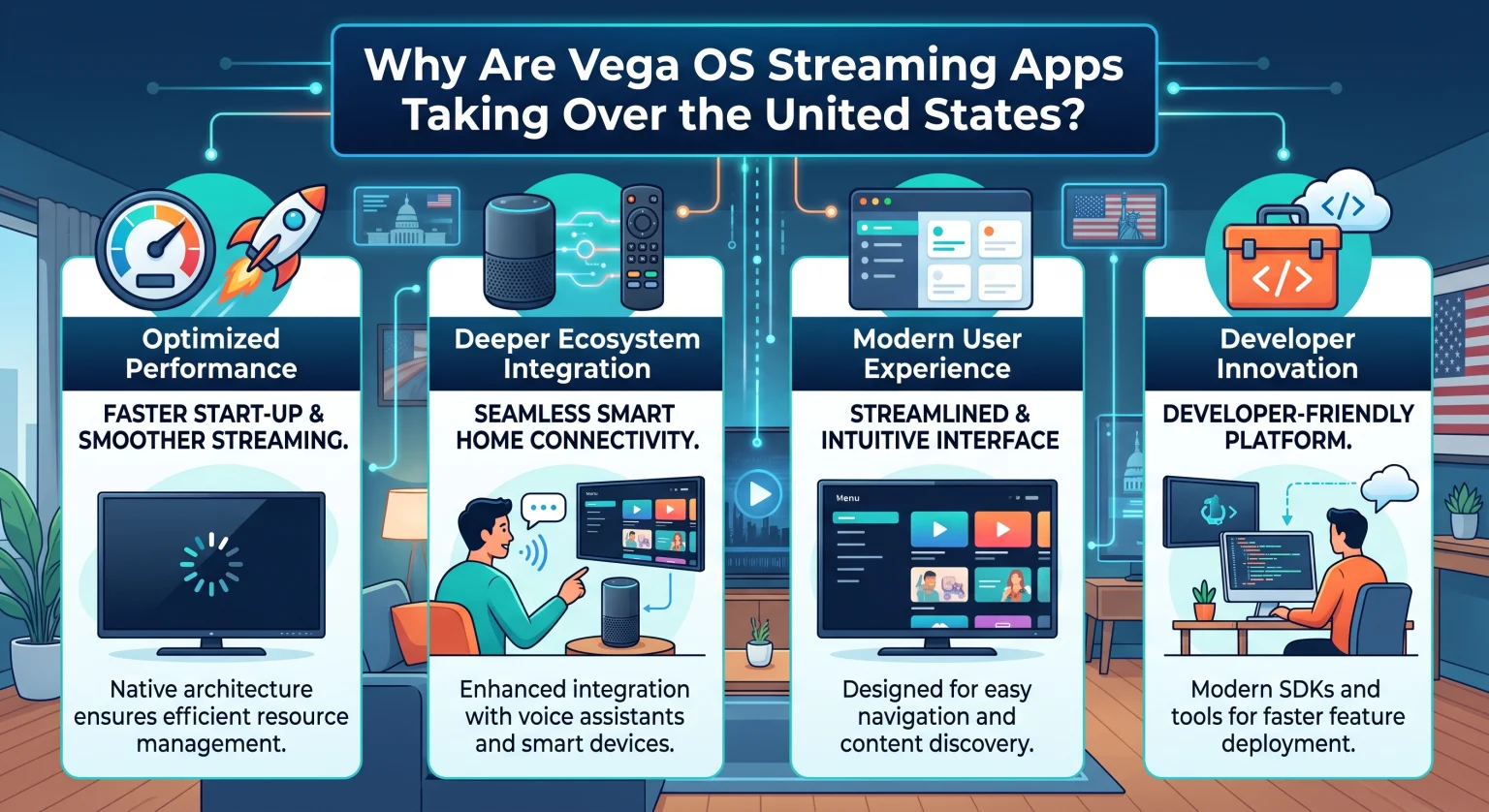
To understand why the industry is changing, let’s look at how Amazon’s new platform stacks up against its predecessor and Apple’s premium alternative.
| Característica | Fire OS antiguo | Amazon Vega OS | Apple tvOS |
| Underlying Architecture | Android (AOSP) | Basado en Linux | iOS-based |
| Primary App Framework | Java / Kotlin | React Native | Swift / Objective-C |
| Media Playback Engine | Android Media Stack | W3C Media APIs | AVFoundation |
| App Sideloading | Yes (Supported) | No (Blocked) | No (Blocked) |
Preparing for the Amazon Fire TV App Migration
If your media business relies on Fire TV viewership, you cannot afford to wait. Amazon is temporarily utilizing a cloud-streaming bridge to keep legacy apps functional. However, this stopgap is reportedly ending by mid-2026.
Once this bridge closes, only fully native Vega OS streaming apps will remain available to users. A comprehensive Amazon Fire TV app migration typically takes 10 to 14 weeks to audit, build, and deploy. Starting your rebuild now ensures your platform experiences zero downtime when the old systems go offline.
Conclusion: Securing Your Spot in the US Market
The transition to a Linux-based platform is an undeniable leap forward for Amazon’s hardware. While rebuilding your platform requires an upfront investment, the resulting Vega OS streaming apps offer unmatched speed, security, and performance.
For brands operating in the United States, staying ahead of this technical curve is absolutely essential for retaining subscribers. Don’t let your app get left behind when the legacy bridge permanently closes.
Ready to modernize your platform? Subscribe to our OTT development newsletter to stay updated, or contact our expert engineering team today to schedule a codebase audit and launch your native Vega OS app in just 12 weeks!
Preguntas frecuentes (PAA)
Can existing Android apps run on Vega OS?
No. Because the new platform is entirely Linux-based and lacks an Android compatibility layer, existing Fire OS APKs cannot be ported or sideloaded. They must be explicitly rewritten using React Native for Vega.
What are the main benefits of Vega OS streaming apps?
These apps benefit from faster startup times, smaller file sizes, and smoother user navigation. By bundling the React Native runtime directly into the OS, Amazon has vastly improved memory management and overall device performance.
How long does it take to rebuild an app for Vega OS?
A standard migration from a legacy Android or React Native app typically takes between 10 to 14 weeks. This timeline includes a full architectural audit, integrating W3C Media APIs, quality assurance testing on real hardware, and final Appstore submission.