
You’ve waited all day for the kickoff, but just as the striker approaches the penalty box, your screen turns into a pixelated mess. If you are wondering why your Champions League streaming quality plummets during crucial moments, you aren’t alone.
Let’s explore the hidden network bottlenecks causing live sports buffering and how to guarantee crystal-clear soccer broadcast latency for the next big game.
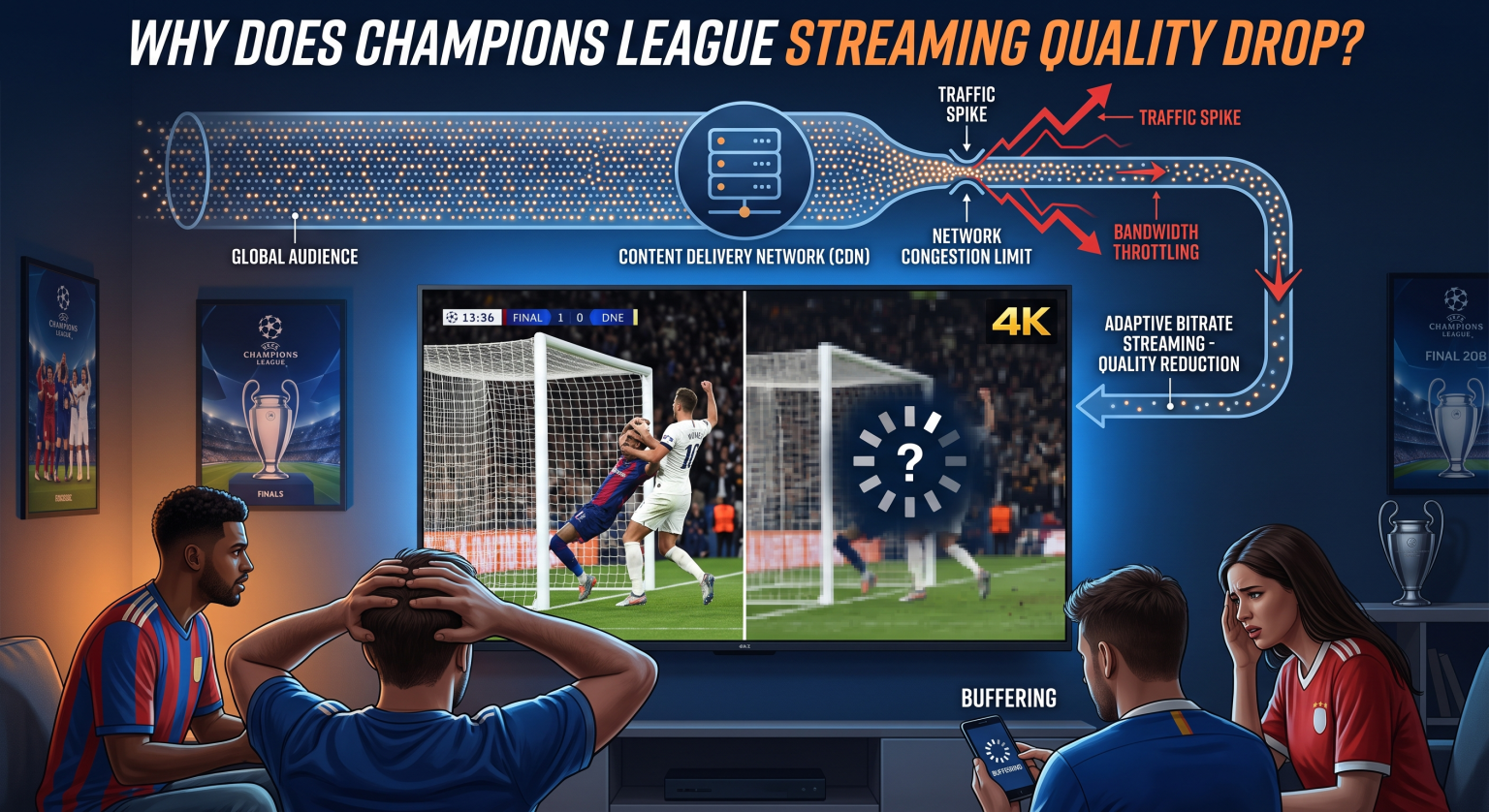
The Reality of Matchday Server Overload
When millions of fans tune in simultaneously across the US from New York to Los Angeles broadcaster servers face unprecedented demand. This massive traffic surge forces streaming platforms, like Paramount+ or CBS Sports, to implement adaptive bitrate streaming.
Instead of letting the UEFA stream lag completely and freeze, the platform automatically lowers your video resolution to keep the feed playing. This is why a crisp 4K picture suddenly looks like a 720p blur.
How Local US ISPs Impact Your Viewing
Your home network plays a huge role in football streaming resolution. During high-stakes knockout stages, local Internet Service Providers (ISPs) like Comcast or Spectrum often experience neighborhood-wide congestion.
Even if you pay for gigabit speeds, peak evening traffic can cause ISP throttling, limiting your bandwidth right when the match gets intense.
What Actually Happens Behind the Scenes?
| Streaming Factor | Standard Group Stage Match | High-Stakes Knockout Match |
| Broadcaster Server Load | Moderate (Normal traffic distribution) | Extreme (Millions of concurrent US viewers) |
| Résolution vidéo | Consistent 1080p or 4K UHD | Fluctuates between 720p and 1080p |
| Local ISP Bandwidth | Stable and unthrottled | High congestion, potential throttling |
Proven Ways to Lock in High-Definition Streams
You don’t have to settle for poor Champions League streaming quality. First, ditch the Wi-Fi. Connecting your TV or console directly to your router via an Ethernet cable prevents wireless interference and packet loss.
Second, optimize your router’s Quality of Service (QoS) settings to prioritize video traffic. If your local US network still struggles, testing a high-tier VPN might help bypass targeted ISP throttling.
Score the Perfect Setup for the Next Match
Don’t let technical glitches ruin the beautiful game. By hardwiring your connection and optimizing your network, US fans can enjoy flawless, high-definition action from the first whistle to stoppage time.
Ready to upgrade your matchday experience? Check out our top-rated ethernet cables and network optimizers to guarantee perfect Champions League streaming quality today!
Questions fréquentes (FAQ)
Why does my stream buffer only during live sports?
Live events require real-time data encoding and delivery, leaving no time to pre-load or buffer the video in advance. When millions of viewers connect at the exact same moment, the delivery network gets congested.
Can a faster internet plan stop quality drops?
Pas toujours. While a baseline of 25-30 Mbps is recommended for 4K streaming, stability is more important than peak speed. An Ethernet connection often fixes drops better than paying for a faster, but still wireless, plan.
Does restarting my app actually help?
Pas toujours. While a baseline of 25-30 Mbps is recommended for 4K streaming, stability is more important than peak speed. An Ethernet connection often fixes drops better than paying for a faster, but still wireless, plan.
Does restarting my app actually help?
Yes. Restarting clears the temporary cache and can force your device to reconnect to a less congested server node, potentially restoring your high-definition feed.