
L'époque où l'on devait organiser sa soirée en fonction d'un programme TV papier est révolue. Si vous avez déjà regardé une émission sur votre téléphone pendant vos trajets ou rattrapé un match que vous aviez manqué grâce à une application sur votre téléviseur connecté, vous savez déjà que notre façon de consommer les médias a radicalement changé. Au cœur de cette évolution se trouve IPTV.
Mais de quoi s'agit-il exactement, et pourquoi tant de gens abandonnent-ils les abonnements traditionnels au câble et au satellite pour acheter un IAbonnement à PTV? Voici une explication détaillée du fonctionnement de cette technologie en coulisses.
Qu'est-ce que la TVIP ?
IPTV signifie Protocole Internet Télévision. Au lieu de capter les signaux de télévision sous forme d'ondes radio via une antenne de toit, une antenne parabolique ou un câble coaxial, vous recevez vos contenus multimédias via une connexion Internet haut débit classique.
Lorsque vous utilisez un service IPTV, vos programmes télévisés sont diffusés selon le même modèle client-serveur que celui utilisé pour la messagerie électronique et le chargement de vos sites Web préférés. Comme le flux est diffusé en ligne, il n'y a aucune dépendance géographique vis-à-vis d'une ligne câblée physique spécifique : une connexion Internet fiable et un appareil compatible suffisent.
Comment fonctionne l'IPTV ?
La plupart des gens ne se demandent pas ce qui se passe lorsqu'ils cliquent sur “ Lecture ” pour écouter leur morceau préféré Diffusion en continu de la TVIP site. Cependant, la technologie sous-jacente est très différente de celle de la diffusion traditionnelle.
La télévision traditionnelle fonctionne selon un modèle “ push ”. Les chaînes diffusent un signal en continu, et votre antenne de télévision ou votre décodeur câble fait office de récepteur. Vous ne pouvez regarder que ce qui est diffusé à ce moment précis.
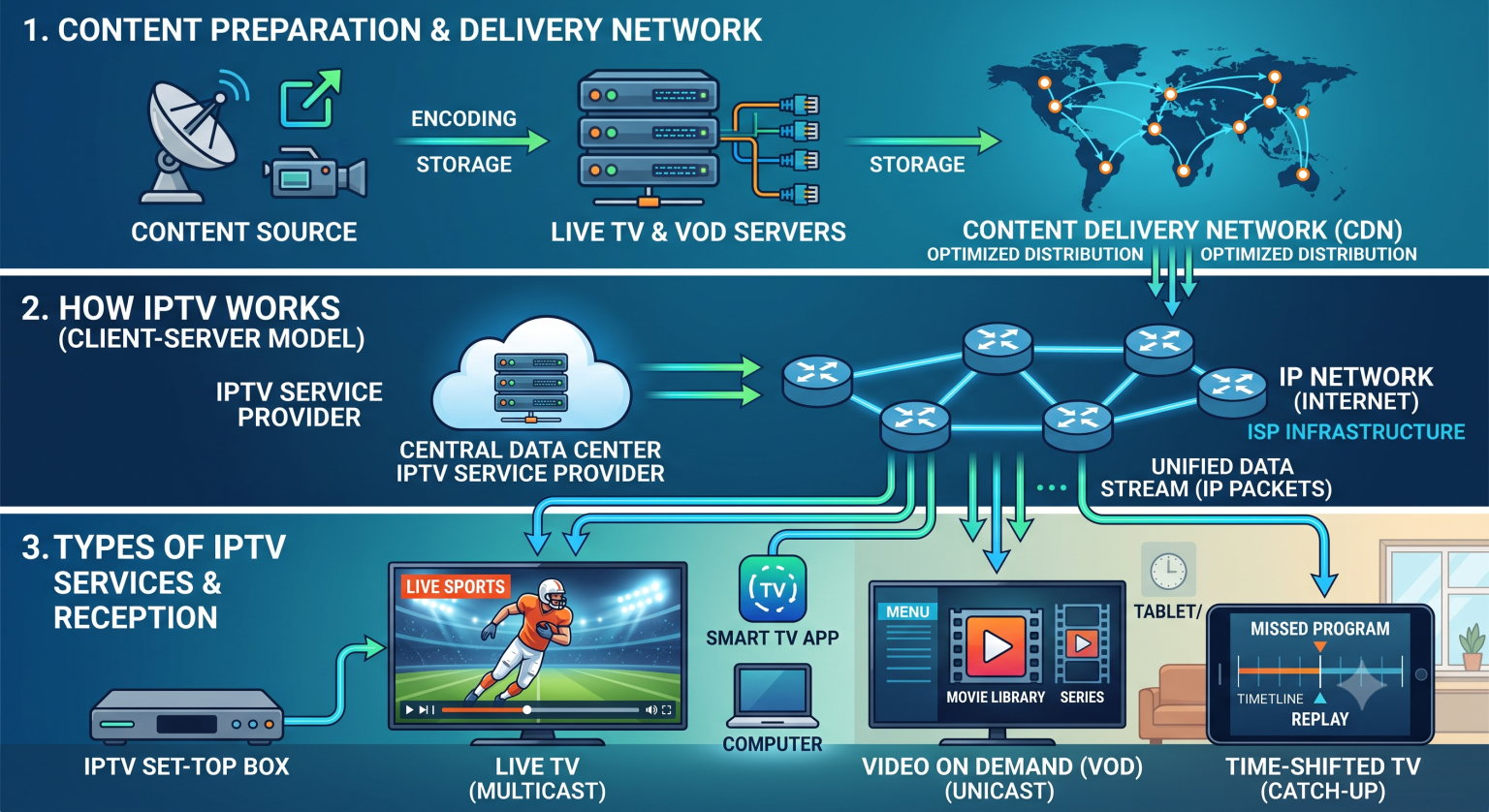
L'IPTV fonctionne selon un modèle “ à la demande ”. Le contenu reste sur le réseau du fournisseur jusqu'à ce que vous en fassiez la demande explicite. Voici, étape par étape, comment ces données s'affichent sur votre écran :
La plupart des gens ne se demandent pas ce qui se passe lorsqu'ils cliquent sur “ Lecture ” sur leur site de streaming IPTV préféré. Or, la technologie sous-jacente est très différente de celle de la diffusion traditionnelle.
La télévision traditionnelle fonctionne selon un modèle “ push ”. Les chaînes diffusent un signal en continu, et votre antenne de télévision ou votre décodeur câble fait office de récepteur. Vous ne pouvez regarder que ce qui est diffusé à ce moment précis.
L'IPTV fonctionne selon un modèle “ à la demande ”. Le contenu reste sur le réseau du fournisseur jusqu'à ce que vous en fassiez la demande explicite. Voici, étape par étape, comment ces données s'affichent sur votre écran :
Préparation du contenu : Les flux TV en direct et les fichiers de vidéo à la demande (VOD) sont capturés puis encodés dans un format numérique (généralement MPEG-4 ou H.264) optimisé pour la diffusion en continu sur Internet.
Réseaux de stockage et de diffusion de contenu (CDN) : Les contenus multimédias encodés sont stockés sur d'énormes serveurs centralisés. Les fournisseurs d'IPTV premium utilisent des réseaux CDN localisés pour s'assurer que ce sont les serveurs les plus proches de chez vous qui traitent votre demande, ce qui réduit le décalage et mise en mémoire tampon.
Transmission de paquets de données : Lorsque vous sélectionnez un film ou une chaîne, le fournisseur divise la vidéo en petits paquets de données. Ces paquets sont transmis sur Internet à l'aide du protocole IP (Internet Protocol).
Décodage en périphérie : Votre appareil, qu'il s'agisse d'un décodeur IPTV dédié, d'une application pour Smart TV, d'un smartphone ou d'un Firestick reçoit ces paquets de données, les réassemble, décode la vidéo et l'affiche sur votre écran en temps réel.
Les trois principaux types de services IPTV
Les services IPTV ne se valent pas tous. Lorsque vous vous abonnez à l' les meilleurs services IPTV, vous obtenez généralement une combinaison de trois formats distincts :
Vidéo à la demande (VOD) : Vous choisissez exactement ce que vous voulez regarder parmi un vaste catalogue de films et de séries, quand vous le souhaitez. Un peu comme Netflix ou Hulu.
Télévision en différé : Cela vous permet de regarder les émissions que vous avez manquées. Ce service est similaire à la VOD, mais les contenus ne sont généralement disponibles que pendant une durée limitée (par exemple, la fonction de rattrapage de BBC iPlayer).
IPTV en direct : Diffusion télévisée en direct sur Internet, au fur et à mesure des événements. C'est essentiel pour la retransmission en direct d'événements sportifs, d'actualités et de cérémonies de remise de prix.
IPTV ou télévision traditionnelle : la comparaison ultime
Si vous hésitez à vous passer de la télévision par câble, il est essentiel de bien comprendre les différences techniques et pratiques entre les différentes options qui s'offrent à vous.
| Fonctionnalité | IPTV | Télévision par câble | Télévision par satellite |
| Méthode de livraison | Protocole Internet (haut débit/Wi-Fi) | Câbles physiques coaxiaux ou à fibre optique | Signaux radio sans fil via l'espace |
| Matériel requis | Smart TV, décodeur, Firestick ou application mobile | Décodeur fourni par l'opérateur | Antenne parabolique et décodeur |
| Dépendance à l'emplacement | Très facile à transporter ; fonctionne partout où il y a une connexion Internet | Strictement lié au câblage physique de votre logement | Fonctionne partout où l'antenne parabolique dispose d'une vue dégagée sur le ciel |
| Interactivité et VOD | Élevé ; entièrement axé sur le contenu demandé par les utilisateurs | Faible ; repose traditionnellement sur des horaires fixes | Faible ; principalement des grilles de programmes en direct |
| Fiabilité météorologique | Excellent (à condition que les connexions Internet ne soient pas perturbées) | Excellent | Mauvaise ; de fortes pluies ou chutes de neige peuvent perturber le signal |
| Utilisation de la bande passante | Partage la bande passante avec votre réseau domestique | Réseau dédié ; n'affecte pas le Wi-Fi de votre domicile | Réseau dédié ; n'affecte pas le Wi-Fi de votre domicile |
Pourquoi ce changement a-t-il lieu ?
La forte augmentation du volume de recherche pour des termes tels que “Essai IPTV” et “meilleur fournisseur d'IPTV” met en évidence un changement radical dans le comportement des consommateurs. Les avantages sont difficiles à ignorer.
Tout d'abord, l'IPTV offre des avantages inégalés flexibilité. Comme vous n'êtes pas lié à un décodeur physique, vous pouvez regarder les contenus de votre abonnement sur le téléviseur de votre salon, passer ensuite sur votre ordinateur portable au bureau, puis terminer l'épisode sur votre téléphone pendant que vous êtes dans le train.
Deuxièmement, le personnalisation est supérieur. Au lieu de payer pour des centaines de chaînes que vous ne regardez jamais, de nombreux sites de streaming IPTV modernes offrent une personnalisation très fine, vous permettant de créer des listes de lecture ou de ne vous abonner qu'aux genres qui vous intéressent.
Le seul véritable inconvénient est que l'IPTV dépend entièrement de votre connexion Internet. Si votre FAI subit une panne ou si votre réseau Wi-Fi domestique est saturé aux heures de pointe, votre expérience télévisuelle en pâtira également. Cependant, à mesure que l'Internet haut débit par fibre optique s'impose comme la norme mondiale, ce goulot d'étranglement est en passe de devenir une chose du passé.