
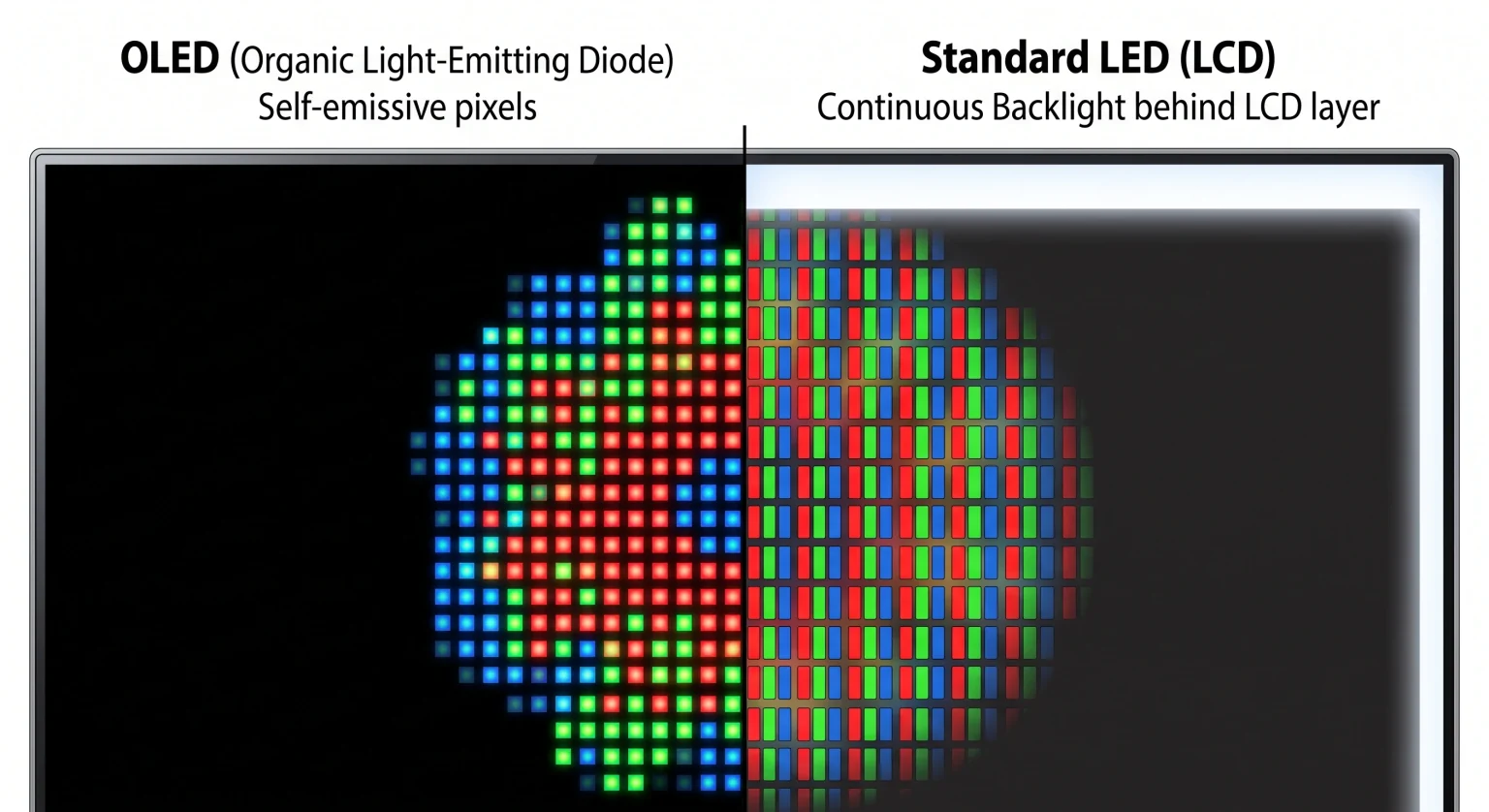
OLED televisions provide some of the best picture quality available today. When you stream television channels using an IPTV service, your television display technology changes how the final video looks. OLED stands for Organic Light-Emitting Diode. Unlike standard LED televisions, OLED screens do not use a backlight. Instead, every individual pixel produces its own light. This technology creates perfect black colors and infinite contrast.
However, an OLED screen is very accurate. It shows exact details. If an IPTV video stream has a high resolution and a high bitrate, the image will look spectacular on an OLED TV. If a video stream has a low bitrate or heavy compression, an OLED TV will display those visual imperfections clearly. Therefore, whether an IPTV OLED TV combination looks better depends heavily on the quality of your source video and your internet connection.
Krótka odpowiedź
Yes, IPTV looks better on OLED TVs when the video source has a high resolution and a high bitrate. OLED panels provide perfect contrast, vibrant colors, and very fast motion handling. This makes 4K and 1080p high-definition streams look excellent. However, OLED screens are extremely accurate. If you watch a low-quality, highly compressed video stream, the OLED TV will show the compression artifacts more clearly than a standard LED television. For the best experience on an OLED TV, you must use a high-quality video source.
How OLED Technology Affects Video Streaming
To understand how an OLED TV displays IPTV streams, you must understand how the screen works. Traditional LED and QLED televisions use a large backlight behind the screen. This backlight shines through a liquid crystal display (LCD) panel to create the image.
An OLED television works differently. Every single pixel turns on and off independently. When a scene requires the color black, the OLED pixels turn off completely. This creates perfect black levels. Because the black levels are perfect, the other colors look much brighter and more realistic.
For high-quality IPTV streams, this technology provides a beautiful image. Movies and television series with dark scenes look perfect because there is no light bleeding from a backlight. However, this exact precision means the television hides nothing. A standard LED TV often blurs small digital errors. An OLED TV shows every digital error clearly.
High Bitrate vs. Low Bitrate Streams
The quality of your IPTV OLED TV experience depends on the video bitrate. Bitrate is the amount of data transferred per second in a video stream.
High Bitrate Streams When you watch a 4K or 1080p stream with a high bitrate, the video contains a lot of data. The OLED television uses this data to display sharp edges, smooth color transitions, and fine details. Premium services like TV Shadow IPTV often provide high-quality streams that look excellent on OLED displays.
Low Bitrate Streams When you watch a stream with a low bitrate, the video data is heavily compressed. Compression removes data to make the file size smaller. This creates visual errors called artifacts. Common artifacts include blocky squares in dark areas and fuzzy edges around people. Because an OLED screen has infinite contrast, these blocky squares become very visible. If you frequently watch low-quality streams, you might want to read our guide explaining Dlaczego obraz z IPTV jest rozmyty na nowym telewizorze 4K?].
Watching Live Football on OLED Displays
Live football and other fast-moving sports look very different on an OLED TV compared to a standard LED TV. Sports broadcasts require a television that handles fast motion well.
When a football moves quickly across the screen, a television needs a fast pixel response time. Pixel response time is the time it takes for one pixel to change from one color to another color. Standard LED televisions usually have a response time between 3 and 8 milliseconds. This slow response time creates a blur trail behind the moving football.
OLED televisions have a near-instant pixel response time, often around 0.1 milliseconds. Because the pixels change color instantly, fast motion remains sharp. There is almost no motion blur. This makes OLED an excellent choice for watching live football.
However, you must also consider the refresh rate. The television refresh rate works together with the pixel response time. If you want to learn more about refresh rates for sports, read our comparison of Telewizory 60 Hz a 120 Hz do oglądania meczów piłki nożnej na żywo.
Comparison: OLED vs Standard LED for IPTV
This comparison table highlights the main differences between an OLED TV and a standard LED TV when streaming live television.
| Funkcja | OLED TV | Standard LED TV |
| Pixel lighting | Self-lit individual pixels | LED backlight panel |
| Contrast and black | Perfect black, infinite contrast | Dark gray black, limited contrast |
| Motion handling | Near-instant response, excellent for sports | Slower response, can cause motion blur |
| Peak brightness | Good, but lower than premium LED | Very high, excellent for bright rooms |
| Low-quality streams | Shows compression artifacts clearly | Hides some digital noise and artifacts |
| Risk of image burn-in | Small risk with static logos over time | No risk of permanent burn-in |
Systemy operacyjne telewizorów Smart TV i aplikacje IPTV
An OLED television is a Smart TV. The brand of the OLED television determines the operating system. The operating system determines which IPTV applications you can install.
LG manufactures many popular OLED televisions. LG televisions use the webOS operating system. The LG Content Store has many popular IPTV players available to download.
Sony also manufactures premium OLED televisions, known as the Sony BRAVIA OLED series. Sony televisions use the Google TV operating system. Google TV gives you access to the Google Play Store. The Google Play Store has the largest selection of IPTV applications.
If you are trying to choose between these two major OLED brands, you can read our detailed guide comparing Sony BRAVIA vs LG Smart TV for IPTV.
Always verify that your preferred IPTV application is compatible with the television operating system before you buy a new OLED TV. TV Shadow IPTV works with most major applications, but the application must exist in the television app store.
Important Features for the Best Experience
If you decide to buy an OLED TV for IPTV, ensure the television and your setup include these features:
Wired Ethernet Connection OLED televisions show high-quality streams beautifully. To maintain a high-quality stream, you need a stable internet connection. Wi-Fi connections can lose speed due to walls or distance. Connect your OLED TV directly to your internet router using an Ethernet cable. This ensures the television receives the video data constantly.
Good Video Upscaling Many live television channels broadcast in 720p or 1080i resolution. Modern OLED televisions have a 4K resolution. The television must stretch the 720p image to fit the 4K screen. This process is called upscaling. Premium OLED brands like Sony and LG have very good internal computer processors. These processors use artificial intelligence to improve the low-resolution image before displaying it on the screen.
Picture Settings Adjustment When you watch IPTV on an OLED TV, you should adjust the picture settings. Turn off excessive artificial sharpness. High artificial sharpness makes digital compression artifacts look worse. You should also enable the motion smoothing settings carefully if you are watching 50 frames-per-second (fps) sports broadcasts.
Wnioski
An IPTV OLED TV combination can provide a fantastic home entertainment experience. Because OLED technology uses self-lit pixels, you get perfect black levels and incredible contrast. The fast pixel response time also makes OLED televisions excellent for watching live football and fast sports.
However, you must use high-quality video sources. An OLED screen is so accurate that it will reveal digital errors and blocky artifacts in low-bitrate streams. Standard LED televisions are sometimes better at hiding these errors, but they cannot match OLED contrast. If you use a premium service with high-resolution streams like TV Shadow IPTV, an OLED television is an excellent investment for your living room.
Najczęściej zadawane pytania
Does an OLED TV stop IPTV buffering?
No, an OLED TV does not stop buffering. Buffering happens when your television does not receive video data fast enough from the internet. To stop buffering, you must improve your internet speed or connect your television using an Ethernet cable.
Will channel logos cause burn-in on an OLED TV?
Burn-in is a permanent image stuck on the screen. It can happen on OLED televisions if a bright, static image stays on the screen for many hours every day. Live television channels often have a static logo in the corner. However, modern OLED televisions from 2024, 2025, and 2026 have built-in software protections. They automatically dim the channel logo and shift the screen pixels slightly to prevent burn-in.
Do standard definition (SD) channels look good on a 4K OLED?
No, standard definition channels usually look poor on a large 4K OLED screen. An SD video has very little detail. The OLED television will try to upscale the video, but the image will look blurry and soft. You should watch high-definition (HD) or 4K channels whenever possible.