
If you are tired of the dreaded loading wheel freezing your screen right in the middle of a live sports match, you are not alone. Making the jump to an Abonament IPTV is a massive upgrade over traditional cable, but the whole setup relies on one critical factor: your home network.
The most common question new cord-cutters ask before looking for the najlepszy dostawca usług IPTV is exactly how much bandwidth is required to stream live TV smoothly. Providers often throw around different numbers, which can make things confusing.
The short answer? You need a minimum of 15 Mbps for High Definition (HD) and at least 30 Mbps for 4K streaming. But in the real world, minimum requirements rarely tell the whole story.
If you want a truly stable IPTV experience, here is exactly what you need to know about your internet connection.
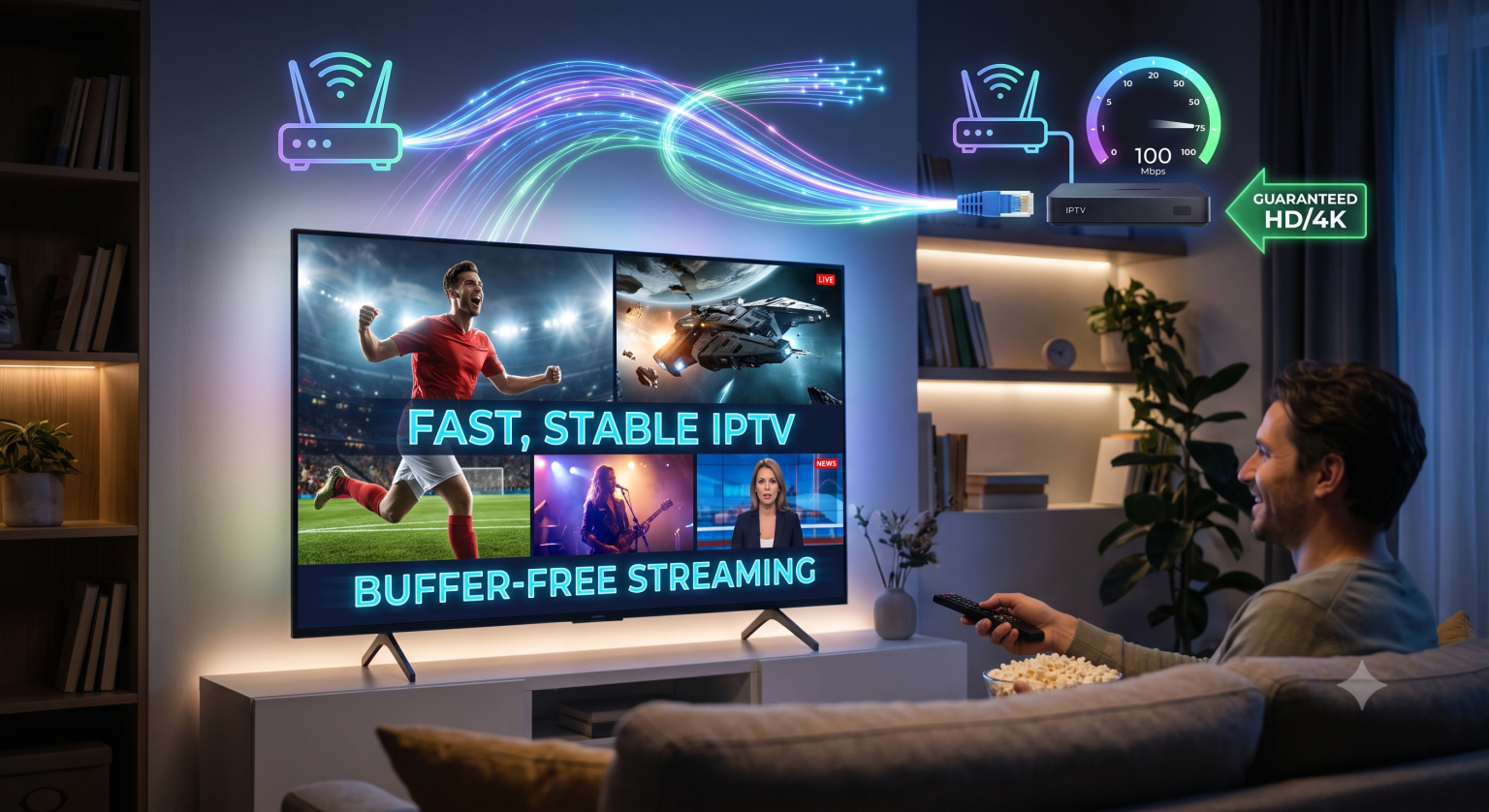
IPTV Speed Requirements by Resolution
Streaming live television is fundamentally different from watching a pre-recorded YouTube video or Netflix show. Netflix can preload a few minutes of a show in advance so that if your internet dips, the video keeps playing. Live television feeds cannot do this. You are downloading the broadcast in real-time, which means your connection needs to be both fast and relentless.
Whether you are using an IPTV Android box lub IPTV Smart TV app, here is the breakdown of what you actually need based on the picture quality you expect:
| Video Quality | Minimum Speed | Recommended Speed |
| SD (480p) | 3 Mbps | 5 Mb/s |
| HD (720p/1080p) | 10 Mb/s | 15 Mb/s |
| 4K Ultra HD | 25 Mb/s | 50 Mbps |
High Definition (HD)
This is the sweet spot for the vast majority of households. Streaming in 1080p provides a crisp, clear picture for live sports, news, and movies. While any najlepsza usługa IPTV might claim you only need 10 Mbps for HD, aiming for a consistent 15 Mbps gives you the necessary “headroom” to prevent pixelation during fast-moving action scenes.
4K Ultra High Definition (UHD)
More providers are now offering dedicated 4K channels, particularly for major pay-per-view events. 4K pushes four times as many pixels as standard HD, meaning it eats through data. While the absolute floor for a single 4K stream is 25 Mbps, a 50 Mbps connection is highly recommended to ensure you get IPTV without buffering.
The Household Factor: Sharing the Bandwidth
One of the biggest mistakes people make when they buy IPTV online is looking at their internet plan and assuming that number applies solely to their television.
Bandwidth is like a highway. If your internet plan gives you 50 Mbps, that is your total highway capacity. Every device in your home acts as a car taking up a lane.
If you are watching an HD stream (using 15 Mbps), but your partner is on a Zoom call (using 5 Mbps), someone else is gaming in the bedroom (using 10 Mbps), and two smartphones are updating apps in the background, your network is suddenly stretched thin.
To calculate your actual needs:
Add up the peak usage of every person in your house during the evening.
Add an extra 20% to that total as a safety net.
If your current internet plan falls below that number, it is time to call your ISP.
For a typical family of four, a stable 100 Mbps fiber or cable connection is generally the baseline to keep everyone happy without anyone experiencing lag.
Ping and Stability: The Hidden Culprits
Fast internet does not guarantee a good stream. You can have a 1 Gigabit connection (1,000 Mbps) and still experience horrible lag if your connection drops packets or suffers from high latency.
Ping (Latency) measures how fast data travels from your provider’s server to your device. For live broadcasts, you want a ping that is as low as possible.
Under 20ms: Excellent.
20ms to 50ms: Good, entirely acceptable.
Over 100ms: You will likely experience delays, audio sync issues, and freezes.
A connection that fluctuates wildly bouncing between 10 Mbps and 100 Mbps will cause your TV to stutter. You want a connection that delivers a flat, consistent speed. This is why finding a high-quality server is just as important as having fast internet.
The Golden Rule for IPTV Without Buffering
If you take only one piece of advice away from this guide, let it be this: never use Wi-Fi if you can avoid it.
Wi-Fi is convenient, but it is inherently unstable. It is subject to interference from thick walls, microwaves, neighboring networks, and physical distance from the router. A sudden dip in your Wi-Fi signal will instantly cause a live feed to freeze.
Always hardwire your streaming device directly to your router using an Ethernet cable. An Ethernet connection guarantees zero signal loss, lower latency, and gives your TV 100% of the speed your router is receiving. If your router is in another room, consider investing in a set of Powerline adapters, which route your internet connection through the electrical wiring in your walls.