
Does your stream load perfectly on a wired connection, but instantly fails wirelessly? If your IPTV works Ethernet not WiFi, you are dealing with a localized network configuration error. This specific issue tells you exactly where the problem lies, and fixing it is easier than you might think.
For cord-cutters across the US, a rock-solid connection is the foundation of home entertainment. When your IPTV works Ethernet not WiFi, it proves your subscription and ISP are functioning properly. The problem is exclusively isolated to your router’s wireless environment or internal firewall. Let’s break down exactly what causes this frustrating drop-off.
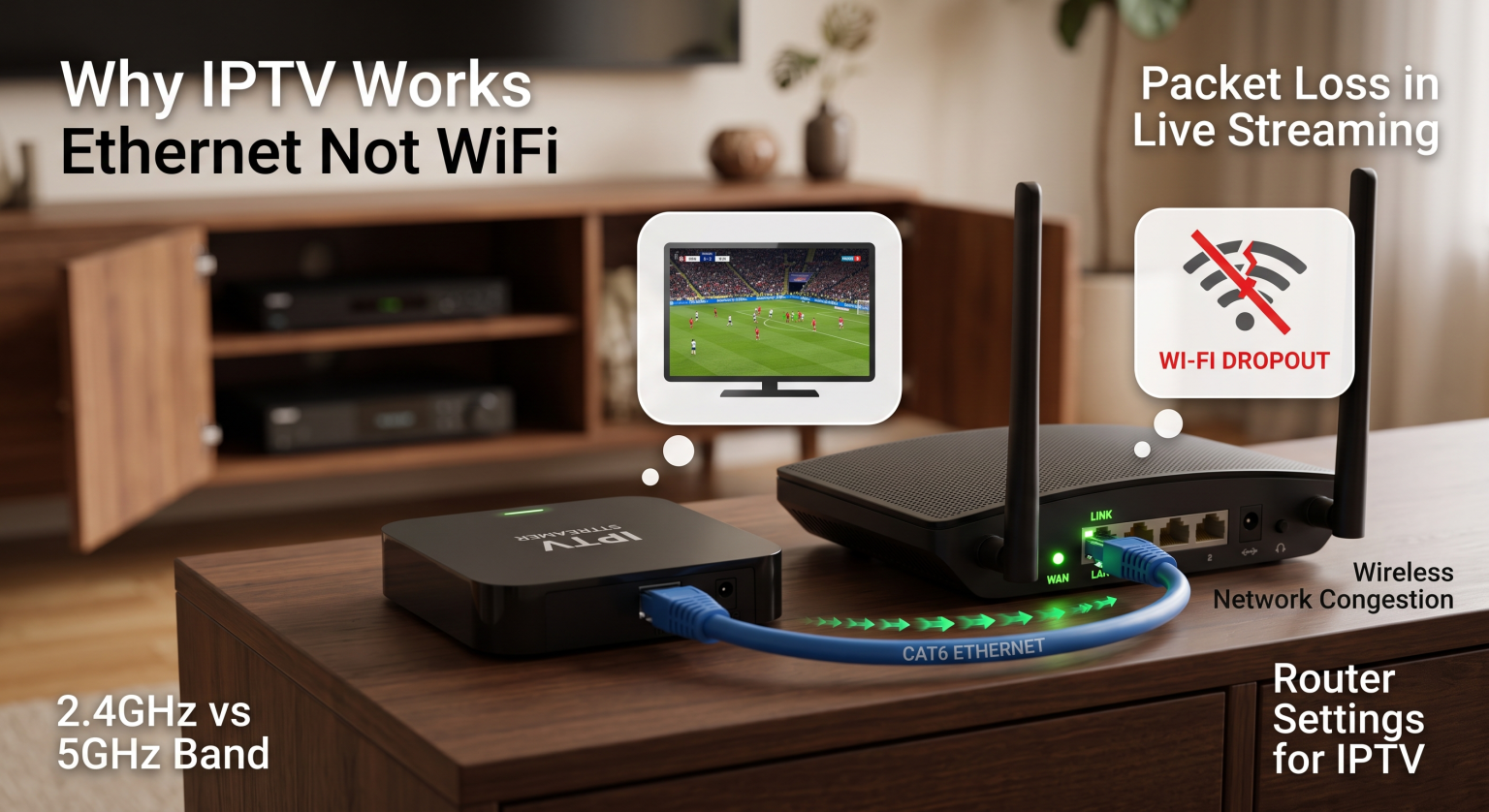
Why Your IPTV Works Ethernet Not WiFi: The Root Causes
When troubleshooting, understanding the “why” is half the battle. If your setup fails wirelessly, it usually comes down to three main culprits hiding in your home network.
1. Wireless Network Congestion
Live video data requires a constant, uninterrupted stream to avoid packet loss in live streaming. Standard 2.4GHz Wi-Fi bands are notoriously crowded with smart home devices, microwaves, and neighboring signals. This severe wireless network congestion easily disrupts the data packets required to keep your live TV app active.
2. AP Isolation and Router Security Rules
Many modern routers use a feature called AP (Access Point) Isolation to protect users. This security measure prevents wireless devices from communicating with certain network protocols. Om din IPTV works Ethernet not WiFi, it is highly likely that your router’s AP isolation is blocking the specific traffic your set-top box needs.
3. IGMP Snooping and Multicast Traffic
Most live TV services rely on multicast traffic to broadcast channels efficiently. While wired ports handle this seamlessly, many routers struggle to process multicast data wirelessly. Without enabling IGMP snooping in your router settings for IPTV, the wireless signal simply drops the heavy data packets.
The US Streaming Standard: Ethernet vs. 5GHz Wi-Fi vs. Powerline
To understand wired vs wireless streaming stability, you need to look at how different connections handle heavy video data loads. Here is a breakdown of the most common connection options for modern US homes.
| Anslutningstyp | Latency & Packet Loss | Real-World Streaming Stability |
| Direct Ethernet | Near Zero | Flawless; handles 4K multicast easily. |
| 5GHz Wi-Fi | Low to Moderate | Good, but highly sensitive to walls and distance. |
| Powerline Adapter | Låg | Excellent alternative if direct Ethernet isn’t possible. |
Step-by-Step Fixes When IPTV Works Ethernet Not WiFi
Ready to ditch the cables and get your wireless connection running smoothly? Follow these quick steps to eliminate the roadblock and restore your service.
Upgrade Your Band Selection
Stop relying on the crowded 2.4GHz frequency. Separate your router’s bands and force your streaming device onto the 2.4GHz vs 5GHz band. The 5GHz channel offers vastly superior speeds and less interference, which is crucial for high-definition streaming.
Adjust Your Router Settings for IPTV
Log into your router’s admin panel and look for the advanced wireless settings. Make these quick changes to restore your stream:
Disable AP Isolation: Ensure “Client Isolation” or “Guest Mode” is turned off so your device can seamlessly communicate with the network.
Enable IGMP Snooping: This critical setting allows multicast live TV traffic to pass through your Wi-Fi interface freely.
Turn off Wireless Firewalls: Briefly disable any strict wireless-only parental controls to see if they are blocking the streaming host.
Update Your DNS Settings
Sometimes, your wireless interface struggles to resolve the provider’s server addresses. Change the DNS settings on your streaming device from “Automatic” to a public resolver like Google (8.8.8.8) or Cloudflare (1.1.1.1). This simple tweak bypasses ISP blocks and often restores wireless connectivity instantly.
Conclusion: Secure Your US Streaming Experience Today
Figuring out why your IPTV works Ethernet not WiFi doesn’t have to be a headache. By tweaking your router settings, optimizing your wireless bands, and understanding how data travels, you can enjoy flawless entertainment anywhere in the US. Don’t let a poorly configured local network ruin your movie night.
Ready to upgrade your viewing experience? Stop dealing with frustrating network drops and switch to a premium, buffer-free service today. [Click here to explore our top-rated, high-speed IPTV subscription plans and start streaming in 4K now!]
Vanliga frågor (FAQ)
Why is my IPTV buffering on Wi-Fi but not Ethernet?
Wi-Fi is highly susceptible to physical interference, distance drops, and bandwidth sharing. Ethernet provides a dedicated, shielded pathway for data, ensuring zero packet loss and eliminating the dreaded IPTV buffering on Wi-Fi.
Do I need a special router for IPTV?
While you don’t strictly need a “special” router, you do need one that can handle high data loads. Look for a dual-band or tri-band Gigabit router that officially supports IGMP snooping and multicast routing.